

How to Create Smooth Transitions from Groove to Breakdown
Last Edited: Aug 21, 2026
One of the biggest differences between a beginner arrangement and a professional one lies in how energy flows throughout the track. In many productions, breakdowns arrive too abruptly. While this approach can work in certain situations, it often feels disconnected from the track's flow. A more effective technique is to gradually transition from the groove to the breakdown. Rather than treating them as two separate sections and removing all elements at once, the roles of the elements change over time. Drums lose their impact as filtering takes hold. Simultaneously, melodic elements become more spacious, and atmospheric layers slowly take over the arrangement. This creates a smooth transition experience for the listener rather than a sudden interruption.
This approach is particularly effective in Organic House, Afro House, and Progressive House. In these genres, maintaining flow is often more important than creating dramatic contrasts. A good breakdown should feel like a natural evolution of the groove that came before it. You should always try to preserve the track's emotional momentum while introducing a new sense of space. In this tutorial, we used a short transition section as an example. Starting sixteen kicks before the breakdown, the drums, bass, and melodic elements will gradually change their character. Rather than introducing new sounds, we reshaped and transformed the existing elements until only the atmospheric components remained.
The goal is not simply to remove energy from the arrangement. The goal is to redirect that energy, allowing the groove to dissolve naturally into the breakdown while keeping the listener engaged throughout the entire transition.
Listening to the Transition in Context
We played the entire transition section we created in context before applying any processing to smooth it. In this example, the transition lasts for approximately 32 kicks, starting from the final groove section and ending at the breakdown.
At this stage, all elements are still playing in their original form. The kick, bass, drums, strings, synth chords, and arp sequence are all present and operating with their full energy. This provides a clear reference point before any automation is introduced.
The purpose of this listening stage is to understand how the arrangement currently behaves and to identify which elements will gradually change their role throughout the transition. Rather than introducing new sounds, the following steps will focus on transforming the existing ones using filtering, delay, reverb, and automation.
Once we have clearly established the groove and its energy, the transition can begin, gradually guiding the listener from a rhythm-driven section into a more atmospheric, spacious breakdown.
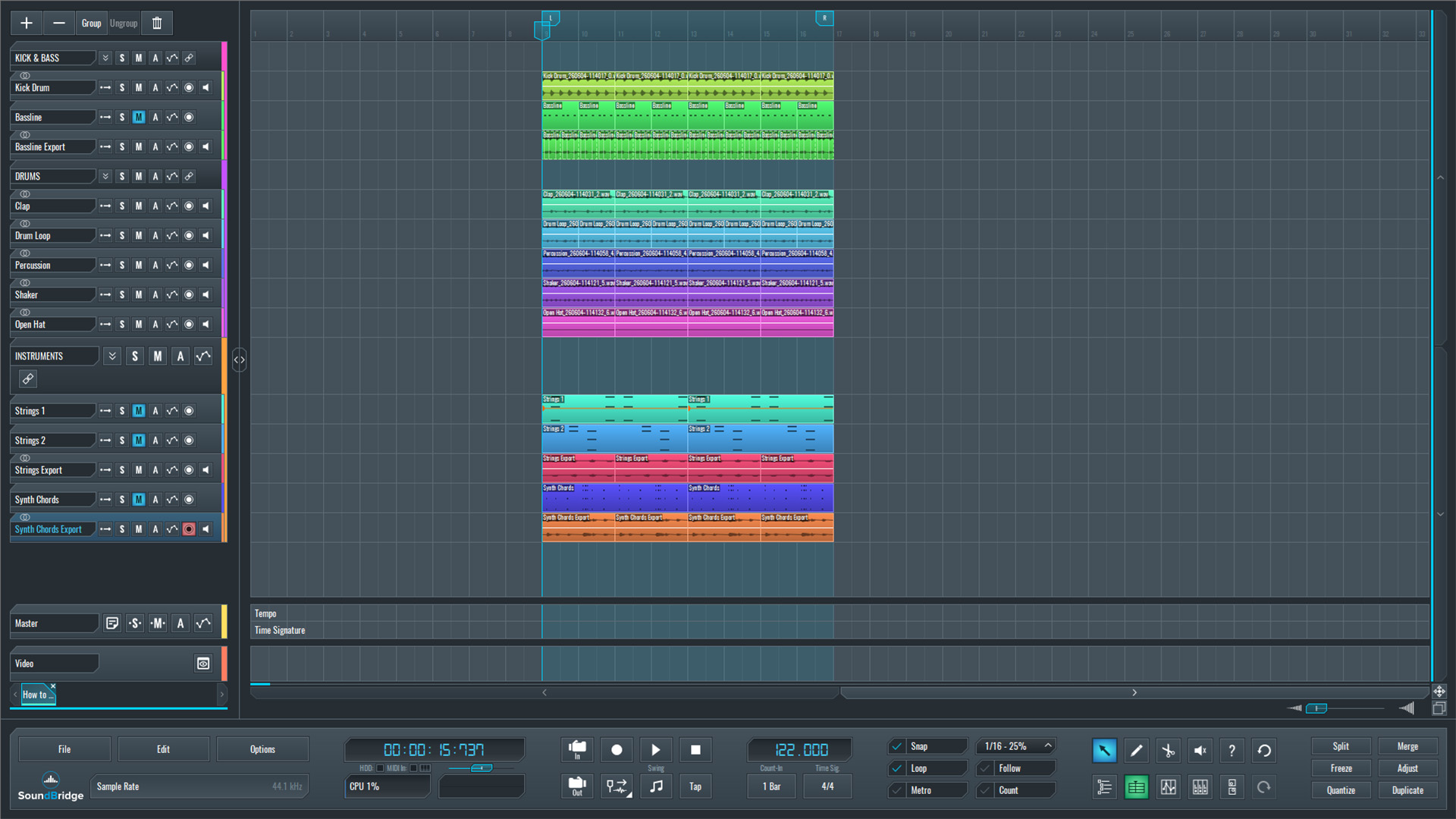
~Full Mix - Unprocessed
Filtering the Rhythm Section For a Smooth Transition Effect
The first step in the transition involves gradually reducing the rhythm section's energy without removing it entirely. Rather than muting elements abruptly, the goal is to slowly reshape their frequency content as the breakdown approaches.
Starting approximately sixteen kicks before the breakdown, we processed both the kick and bass group using a combination of low-cut and high-cut filters. As the automation progresses, the frequency range gradually narrows, reducing both the weight and the definition of these elements. The exact filter ranges differ from those used on the drum group, allowing the kick and bass to retain more of their fundamental energy for a longer period during the transition.
The drum group follows a similar approach, also using both low-cut and high-cut filtering. However, the filter settings are more aggressive, removing a larger portion of the frequency spectrum as the breakdown approaches. This causes the drums to lose their impact and detail more quickly, helping them move into the background while still maintaining the groove.
One advantage of this technique is that the rhythmic information remains present throughout most of the transition. Instead of suddenly removing elements from the arrangement, their energy is gradually reduced, creating a much smoother movement toward the breakdown.
By the end of the automation, both groups occupy a significantly narrower frequency range than at the start. The groove is still recognizable, but its role has changed completely, making room for the atmospheric elements that will take over in the next stage of the transition.
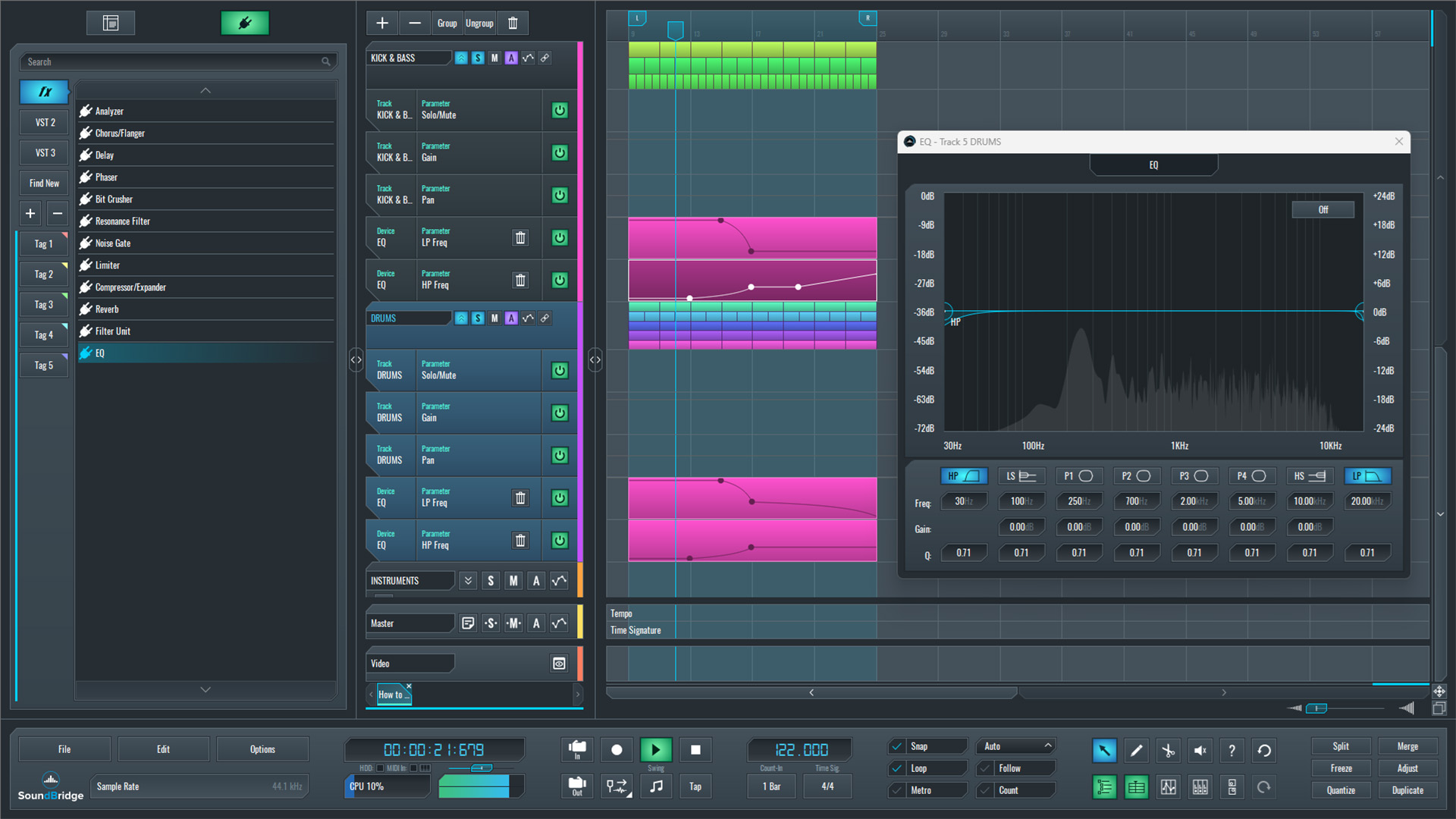
~Kick, Bass & Drums Group - Processed With LC & HC Filter
Extending the Instrument Group with Delay
The next step focuses on the Instruments group, containing the strings and synth chords. To create a smoother transition into the breakdown, we added DelaySon by Sonimus to the group. The delay was synchronized to an eighth note, with a higher feedback setting and an LR Offset of approximately 2 milliseconds for additional stereo movement.
Starting around sixteen kicks before the breakdown, we gradually automated the wet mix upward. As we introduce more delay, the strings and chords slowly blend into the background. By the start of the breakdown, the delay tail continues naturally, helping to connect the groove section to the more spacious arrangement that follows. Let us listen to the Instruments group solo, and then along with the Kick, Bass, and Drums Groups.
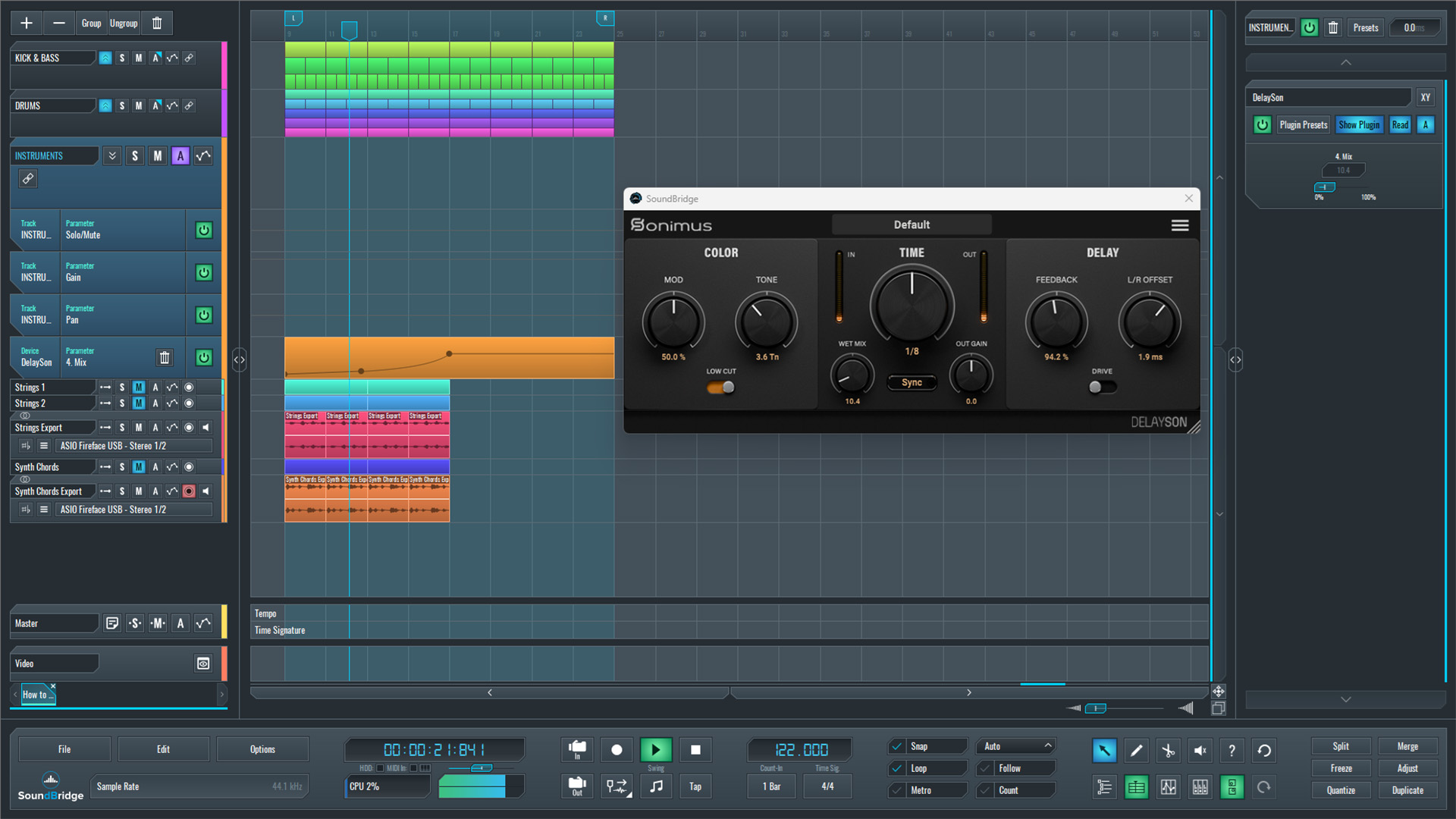
~Instruments Group - Processed With Delay Effect (Solo)
~Kick, Bass, Drums & Instruments Group - Processed
Transforming the Synth Arp into an Atmosphere
The transition's final element is a synth arp, which we created in Vital. Unlike the previous processing stages, the goal here is not to reduce energy but to gradually transform a rhythmic element into an atmospheric one.
To achieve this, several parameters were automated throughout the transition. The first automation controls the filter envelope amount, which gradually opens the cutoff over the course of the 32-kick transition. As the filter opens, more harmonics become audible, and the arp becomes brighter and more present in the mix.
We first monitored the synth arp in solo, making it easier to hear how the filter movement changes its character over time. After that, we played it back in the context of the full mix to hear how it interacts with the filtered drums and delayed instrument layers.
Once the breakdown begins, the focus shifts to the effects section inside Vital. From this point onward, we gradually increased the delay and reverb mixes using automation. The arp slowly becomes less rhythmic and more spacious, with the delay and reverb tails extending further into the arrangement.
By the end of the sequence, the arp has evolved from a groove-driven element into an atmospheric texture, helping carry the listener deeper into the breakdown while blending naturally with the other processed elements.
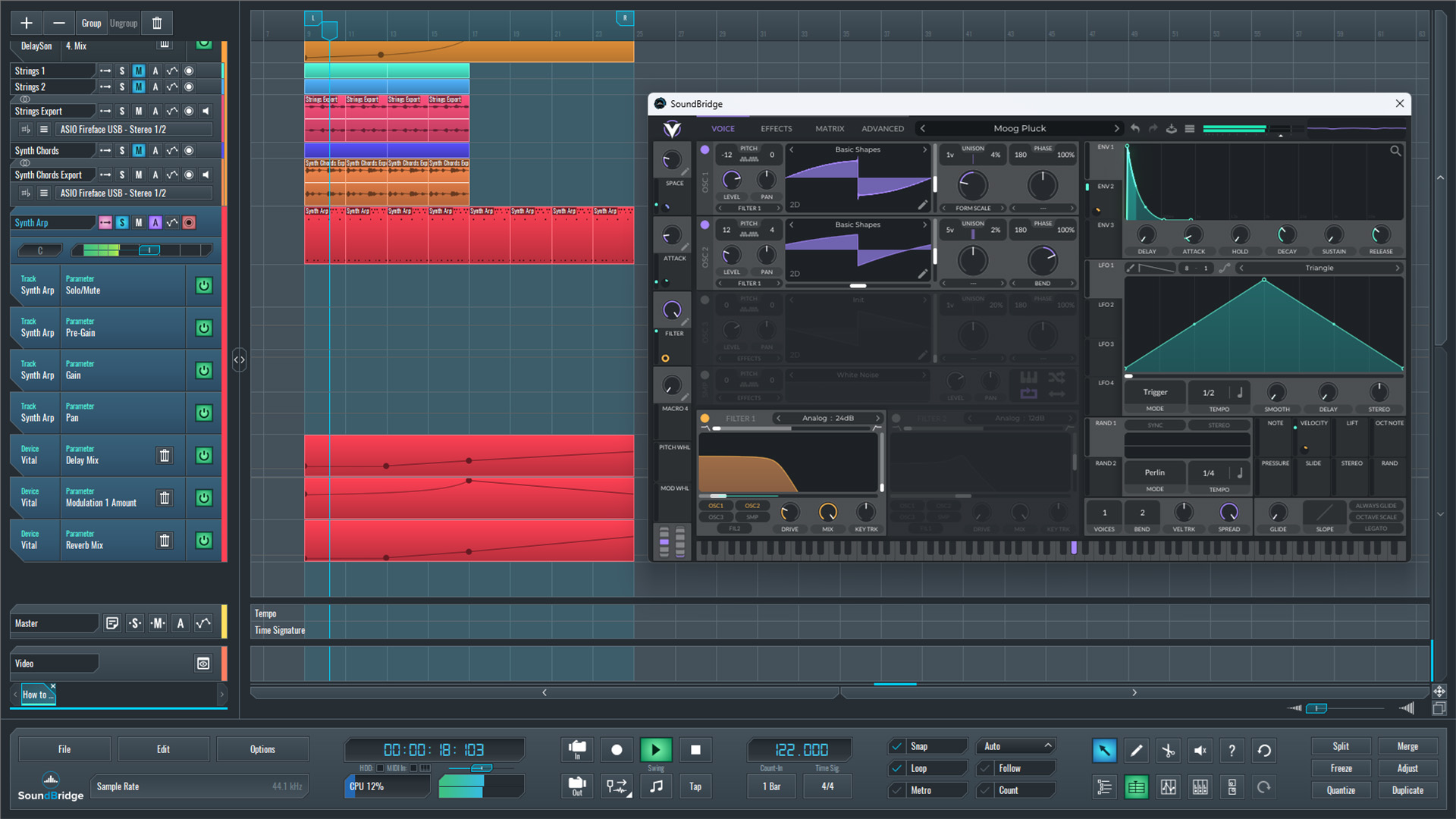
~Synth Arp - Cutoff, Delay & Reverb Automation (Solo)
Adding Drum Fills To Create a Smoother Transition
To complete the transition, we added two final elements just before the breakdown. The first is a simple drum fill that helps signal the upcoming change in energy. Similar to the main rhythm section, we processed this fill with filter automation, gradually narrowing its frequency range as it approaches the break.
Alongside the drum fill, a cymbal effect was introduced to further emphasize the arrival of the breakdown. While simple, these types of transitional sounds can play an important role in guiding the listener through the arrangement and reinforcing key structural moments.
Both elements were first monitored in solo to fine-tune their timing and balance. After that, they were played back in the context of the full mix to ensure they complemented the existing automation rather than competing with it.
Final Thoughts
At this stage, all the individual transition techniques come together. The kick, bass, and drums gradually lose their energy through filtering; the instrument group expands through delay; and the synth arp evolves from a rhythmic sequence into a spacious atmospheric texture through filter, delay, and reverb automation. The drum fill and cymbal effect then provide the final push into the breakdown.
One of the most important lessons from this workflow is that smooth transitions are rarely created by a single effect. Instead, they are usually the result of several subtle changes happening simultaneously across different groups and instruments. Small automations, when combined, create a much more natural movement than any single dramatic processing step.
By transforming the existing elements rather than replacing them, the breakdown feels directly connected to the preceding groove section. The result is a transition that sounds more cohesive, more musical, and ultimately more engaging for the listener.
~Drum Fill & Cymbal FX (Solo)
~Full Mix - Processed
If you liked this article, here are some more on the same subject:
MASTER MUSIC PRODUCTION
Expert-led courses designed to take you from fundamentals to finished tracks.

HOUSEFrom bouncy bass and solid kicks, this course teaches you the most modern House music production techniques needed to succeed and stand out.

TRAPQuit sounding like generic Trap and produce something World with hints of the Far East. Create ethnic soundscapes to put your Trap ahead of the curve.

AMBIENTProduce relaxing, sophisticated psy-influenced ambient. Psychedelic and relaxing to listen to, create meditative soundscapes to put your listeners in Zen.