

How to Design Soft Organic Pad Textures
Last Edited: Apr 16, 2026
In this guide, we will break down a practical approach to designing soft organic pads starting from an initialized synthesizer state. The focus is not on copying a specific sound. Rather, we want you to understand the core principles behind envelope shaping, modulation, and tonal movement. These concepts apply across different synthesizers and production environments for creating pads that feel warm and naturally evolving.
Soft, organic pad sounds play a crucial role in modern electronic music, providing atmosphere and emotional depth without drawing attention to themselves. Unlike sharp leads or rhythmic elements, pads sit behind the groove. They shape the harmonic space and serve the arrangement over time. The effectiveness of pads lies not in complexity, but in balance. Pads usually have soft attacks, slow movement, and subtle imperfections that prevent the sound from feeling static or synthetic.
In contemporary production, organic pads often blur the line between traditional synthesis and textural sound design. Simple waveforms are rarely left untouched. Instead, they are shaped through gentle filtering, modulation, and time-based movement that introduces natural variation. Slight pitch drift, evolving timbre, and controlled randomness help pads feel alive. These movements in pads create a sense of depth that complements both minimal and richly layered arrangements.
Soft, organic pad designs are especially common in ambient, downtempo, organic house, melodic techno, and cinematic-influenced styles. Here, space, tone, and emotional weight are central to the listening experience. Pads act as a foundation, gluing rhythmic and melodic elements together while building the mood and atmosphere.
Establishing the Musical Context
Before diving into sound design, it's important to establish musical context. To do this, we created a simple chord pattern in SoundBridge DAW, without any pad sound applied. At this stage, the pattern exists only as harmonic information, so we can hear the rhythm, voicing, and spacing of the chords without timbre or texture influencing our perception.
Working this way helps separate musical structure from sound design. By removing any existing pad or preset, we create a neutral starting point that makes it easier to judge how each design decision affects the final result. As we build the pad from an initialized state, we'll continuously reference this same pattern, ensuring that every adjustment serves the musical context rather than standing on its own.
This approach allows us to shape the pad around the arrangement from the very beginning. Instead of forcing a finished sound onto a pattern, the sound evolves alongside it, resulting in a pad that naturally supports the harmony, fills the space, and integrates seamlessly into the track.
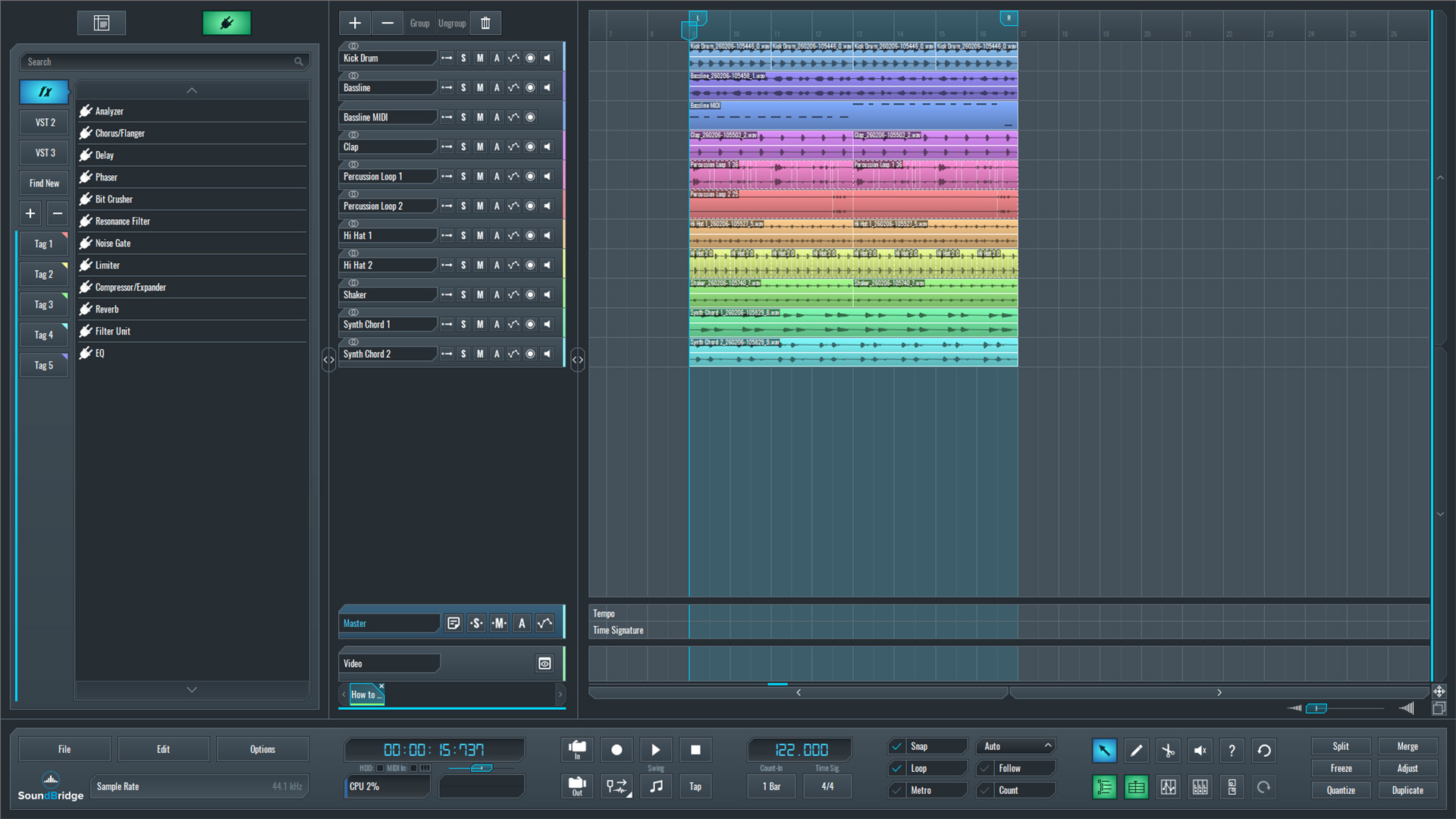
~Full Mix - Without Organic Pad.
Initializing the Oscillators for a Soft Organic Pad Design
For our pad, we'll use a modern wavetable synthesizer as a neutral sound design environment, starting from a fully initialized state. The goal is not to rely on presets or genre-specific macros, but to treat the instrument as a raw signal generator that we can shape step by step. This approach keeps the focus on sound design fundamentals rather than software-specific shortcuts.
By beginning with an init patch, we remove any pre-programmed modulation, effects, or voicing that could influence our decisions. Also, this makes it easier to hear exactly how each parameter (oscillator choice, envelope shape, filtering, and modulation) contributes to the final pad character. Every change remains intentional and directly tied to the musical context we established earlier in the DAW.
Although we used Vital to demonstrate the examples in this guide, the techniques themselves would work on most instruments. The same principles apply to most modern synthesizers: starting clean, gradually building harmonic content, and introducing movement in a controlled, musical way. This way, the resulting pad remains soft, organic, and adaptable across different production setups.
Oscillator Layering and Filter Routing
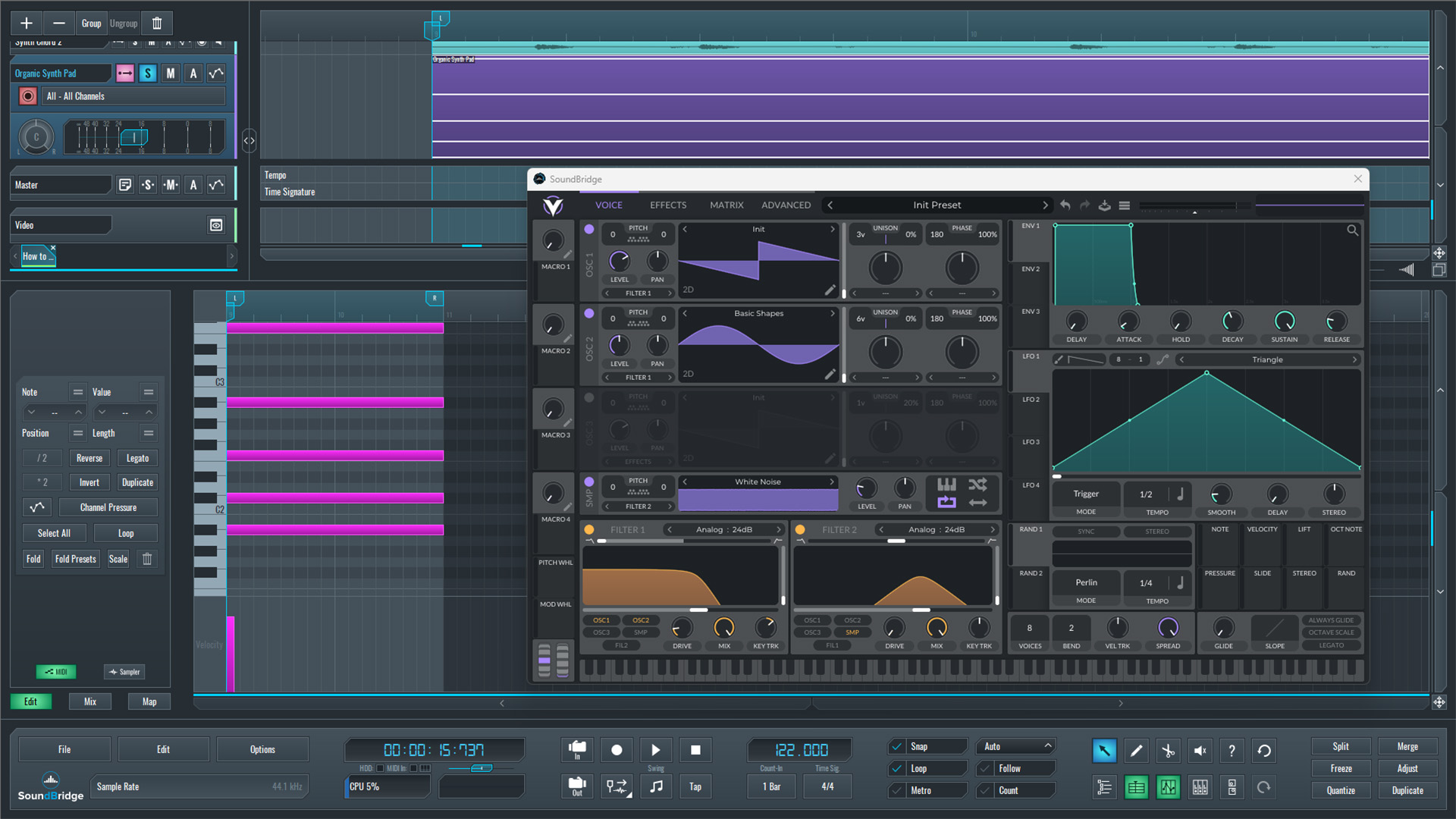
As shown in the image, we built this pad using two standard oscillators combined with a sampler layer set to white noise. The goal of this configuration is to balance harmonic stability with soft textural movement, keeping the sound full but controlled.
We set the first oscillator to a sawtooth waveform and configured it with 3 unison voices, with the detune parameter set to 0%. This first layer provides a wide harmonic foundation without introducing pitch instability. The second oscillator uses a sine waveform, set to 6 unison voices, also with 0% detune. We reduced its level to roughly 30% of the first oscillator, allowing it to reinforce the fundamental and low harmonics without overpowering the main timbre.
We routed both oscillators to Filter 1, which we set to an Analog 24 dB low-pass mode. Resonance is at zero to avoid emphasis around the cutoff point. The cutoff is then set to around one-third of the available frequency range. We added a small amount of drive to introduce gentle harmonic density, and slightly increased key tracking so that higher notes retain clarity and presence.
For additional texture, we added a white-noise sampler layer. Its level is around 30%, keeping it subtle and supportive. We routed this noise layer exclusively to Filter 2 and set the filter to band-pass mode. Here, resonance is low, and we adjusted the cutoff to focus the noise into a narrow frequency band, adding air and movement without masking the oscillators' harmonic content.
This layered and filtered setup creates a soft, harmonically rich pad with controlled brightness and an organic high-frequency texture that integrates smoothly into the mix.
~Organic Pad Texture - Setting up Oscillators & Filters .
Introducing Organic Pitch Variation to Our Soft Organic Pad Design
To add subtle movement and avoid a static, overly clean tone, we introduce controlled pitch variation on the first oscillator. We do this by routing a random modulation source to Oscillator 1's fine-tune parameter.
The modulation is set to bipolar mode, allowing the pitch to fluctuate both above and below the original tuning rather than drifting in a single direction. The modulation amount is kept very low, around 25%, so the variations remain barely perceptible. At this range, the pitch movement does not register as detuning, but as gentle, natural instability.
These small, unpredictable pitch fluctuations help break the digital precision of the oscillator and simulate the behavior of organic or analog sound sources. The result is a pad that feels more alive and expressive. We can best observe these pitch movements on sustained chords, as they work without compromising harmonic stability or musical intonation.
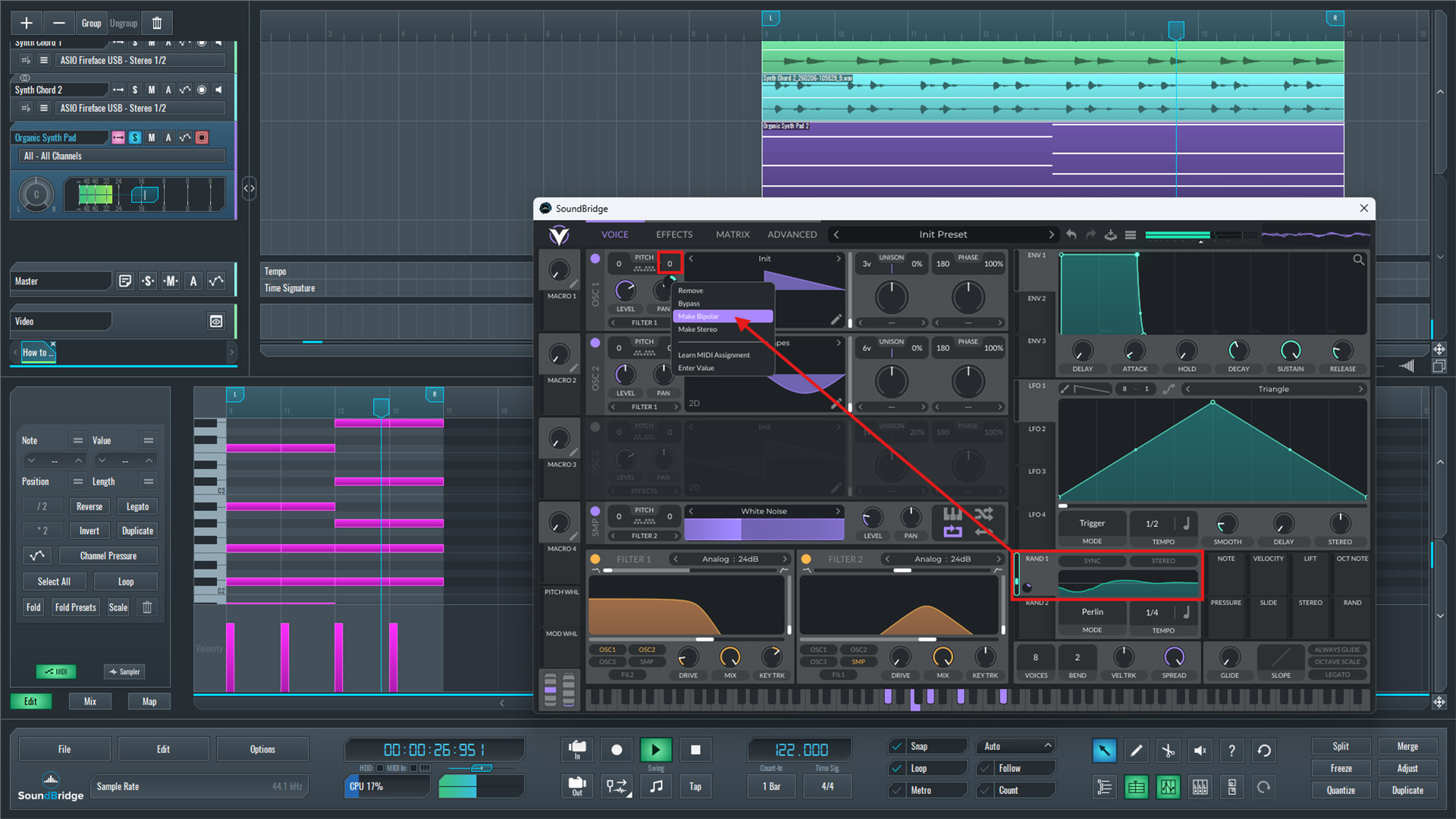
~Organic Pad Texture - Random to Fine-Tune Routing.
Applying Subtle Effects for Texture and Control
In the final stage, we introduce a small chain of effects to enhance depth and character. Each effect is used with a low dry/wet mix. This setting ensures the pad remains soft, balanced, and integrated rather than processed or exaggerated.
A chorus effect is applied first to gently widen the stereo image and add slow, diffuse movement. Used sparingly, it helps the pad feel broader and more spacious while preserving focus in the center of the mix.
Next, we introduced a distortion effect in Downsample mode at a very low intensity. Instead of adding audible grit, this stage slightly reduces digital precision, contributing subtle harmonic texture and a more organic, less pristine feel.
Finally, we used an EQ with a low-cut filter to remove unnecessary low-frequency content. This step tightens the sound and ensures the pad does not interfere with bass elements. It allows the pad to sit cleanly in the arrangement while maintaining warmth and body.
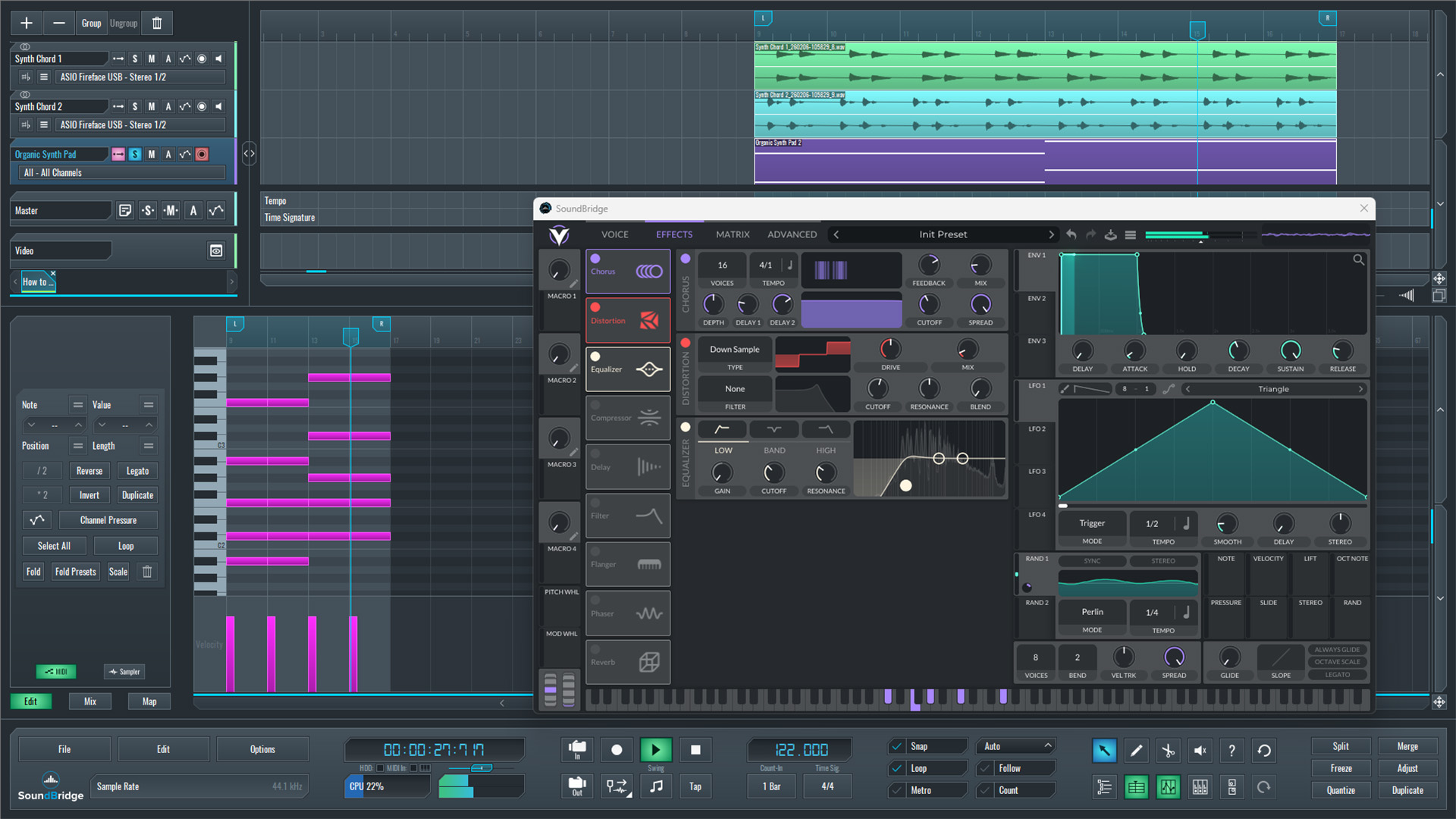
~Organic Pad Texture - Setting up The Effects.
Final Thoughts
As a final step, we automate the cutoff parameter of Filter 1 to introduce slow, musical evolution over time. Rather than keeping the pad static, this automation allows the harmonic content to open and close gently, reinforcing movement across sections and helping the sound breathe within the arrangement.
With the automation in place, we first listen to the organic pad texture in solo. We do this to evaluate its internal movement, tonal balance, and overall softness. This step makes it easier to hear how the modulation, filtering, and subtle effects interact over longer sustained chords.
Finally, we return the pad to the full mix context. Here, the focus shifts to how well it supports the harmony, fills space, and complements rhythmic and melodic elements without competing for attention. The pad serves as an evolving atmospheric background layer, enhancing depth, cohesion, and emotional continuity in the track.
~Organic Pad Texture - Fully Processed (Solo).
~Full Mix - With Organic Pad Texture.
If you liked this article, here are some more on the same subject:
MASTER MUSIC PRODUCTION
基礎から完成曲まで導く、専門家によるコース。

HOUSE弾むベースと堅いキックから、このコースは成功し際立つために必要な最先端のHouse制作テクを教えます。

TRAP凡庸なTrapから脱却し、東洋の香りを混ぜた“World”なサウンドへ。エスニックな音風景でTrapを一歩先へ。

AMBIENTリラックスできる洗練されたサイ寄りAmbientを制作。聴いて落ち着く、禅へ誘うメディテーション系サウンドスケープを作ろう。