

Low Latency Music Collaboration: Your 2026 Guide
Last Edited: Jun 16, 2026
Low latency music collaboration is the practice of enabling real-time synchronous music performance and production over the internet by reducing audio delay to below 30 milliseconds. At that threshold, the human ear stops perceiving the gap between playing a note and hearing it back, making remote sessions feel like a shared room. Tools like OpenStudio and band-app-v2 represent two distinct architectural philosophies for hitting that target, and understanding both will sharpen every remote session you run.
What technologies enable low latency music collaboration?
The core challenge in real-time music collaboration is physics. Audio signals travel through routers, servers, and cables, and every hop adds delay. Two primary architectural approaches have emerged to fight that physics problem.
The first is edge audio routing. OpenStudio targets sub-30ms latency for in-browser jam sessions by routing audio through Cloudflare Calls, which places audio processing nodes geographically close to each participant. Less physical distance means less round-trip time. This is the same principle that content delivery networks use to speed up video streaming, applied directly to live audio.
The second approach sidesteps full audio streaming entirely. Band-app-v2 sends only control signals between players rather than raw audio, achieving sub-50ms round-trip on LAN with quantized inputs. Each player’s instrument is synthesized locally on the host machine, so there is no audio stream to buffer or delay. The tradeoff is that you need compatible virtual instruments on both ends, but the timing stability is exceptional.
Browser-based tools face a hard ceiling because web browsers were not designed for professional audio. The Web Audio API gives developers scheduling and synthesis tools, but it cannot access low-level audio drivers directly. OpenStudio’s Rust native bridge solves this by connecting the browser interface to ASIO on Windows and CoreAudio on Mac over a local WebSocket, approaching the latency levels of fully native desktop apps. This hybrid design is one of the most practical advances in online music production tools in recent years.
Key enabling technologies at a glance:
- Edge audio routing via Cloudflare Calls or similar CDN infrastructure to minimize network hops
- Native audio bridges in Rust or C++ to access ASIO and CoreAudio from browser-based apps
- Control signal architecture where only MIDI-style messages travel the network and audio is synthesized locally
- Beat quantization and shared metronome to lock all participants to a single timing grid
- Web Audio API scheduling for precise audio event timing within browser environments
Pro Tip: If you are building or evaluating a browser-based collaboration tool, check whether it offers a native bridge download. The difference between browser-only and bridged latency can be 20ms or more on the same hardware.
How do popular music collaboration tools compare?
Choosing the right music collaboration software depends on your use case, your network, and how much latency you can tolerate before a session falls apart. Here is a direct comparison of the leading options.
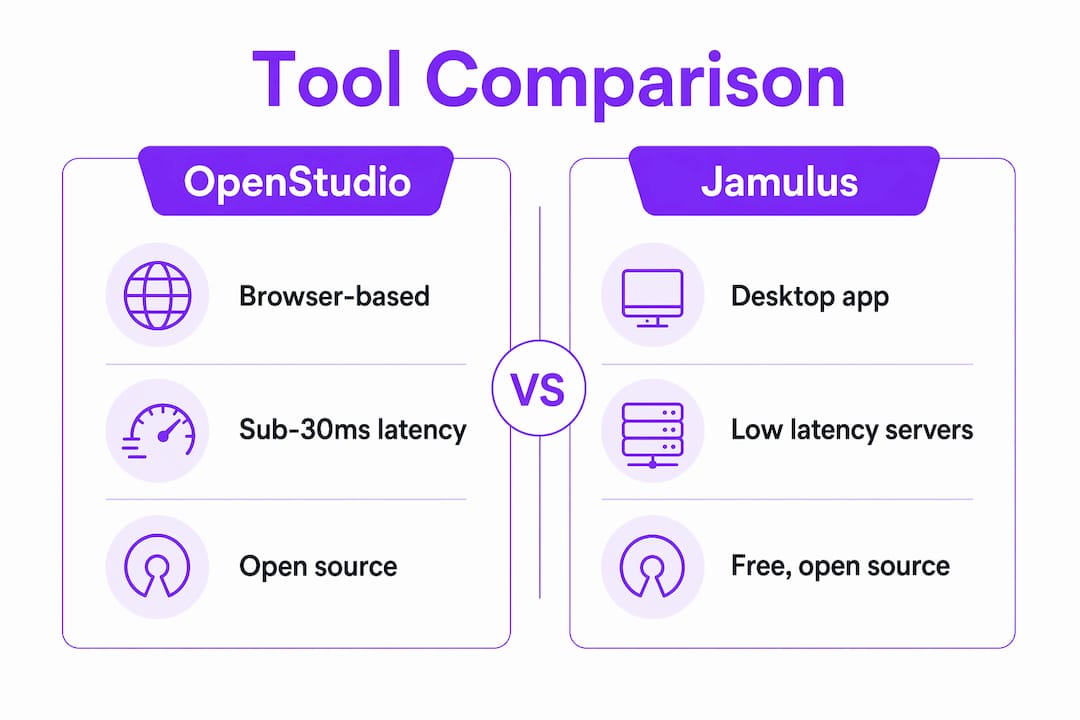
| Tool | Architecture | Latency Target | Open Source | Best For |
|---|---|---|---|---|
| OpenStudio | Browser + Rust native bridge, Cloudflare Calls | Sub-30ms | Yes | In-browser jamming with optional native performance |
| Band-app-v2 | Host/player control signals, local synthesis | Sub-50ms LAN | Yes | Synchronized MIDI-based ensemble play |
| Jamulus | Native desktop, community servers | Sub-30ms broadband | Yes | Free real-time rehearsals and jams |
| JamKazam | Peer-to-peer and client-server hybrid | Broadband dependent | No | Home performances with audio and video |
| FarPlay | Proprietary delay mitigation algorithms | Broadband dependent | No | Multi-user live sessions with audio quality focus |
Jamulus is free and open-source, requires installation, and relies on community-run low-latency servers. It is the go-to for musicians who want a proven, no-cost solution for rehearsals. The catch is that server proximity matters enormously. A Jamulus session routed through a distant server will feel sluggish regardless of your local connection speed.
JamKazam supports both peer-to-peer and client-server models, which gives it flexibility for different network environments. It adds live video to the mix, making it closer to a full telepresence rehearsal experience. FarPlay uses proprietary algorithms for audio delay mitigation and handles multi-user sessions well, particularly for performers who prioritize audio fidelity over raw latency numbers.
OpenStudio and band-app-v2 represent the newer generation of music collaboration software. OpenStudio is browser-first, which lowers the barrier to entry significantly. Band-app-v2’s host-controlled quantization model is the most architecturally interesting: the host acts as the single timing authority, and all player inputs are snapped to the nearest beat grid. This means a server metronome loop and beat quantization keep every participant drift-free even when network conditions fluctuate.
How to optimize your setup for the lowest possible latency
Getting the best results from any real-time music collaboration platform starts with your local hardware and network, not the software itself. The software can only work with what you give it.
-
Use a dedicated audio interface. Generic USB audio built into laptops introduces unpredictable driver latency. Professional audio interfaces minimize device latency by using ASIO on Windows or CoreAudio on Mac, which bypass the operating system’s general-purpose audio stack entirely.
-
Connect via ethernet, not Wi-Fi. Wireless connections introduce jitter, which is the variation in packet arrival times. Even a fast Wi-Fi connection can spike unpredictably. A wired gigabit connection gives you consistent, low-jitter throughput that collaboration apps can rely on.
-
Install the native bridge if your tool offers one. As covered above, browser-only audio has a latency floor that native bridges break through. If you are using OpenStudio, download the Rust bridge and connect it before your session starts.
-
Set your buffer size as low as your CPU allows. Reducing buffering and using direct monitoring lowers total end-to-end latency. Start at 128 samples and drop to 64 if your system handles it without audio dropouts.
-
Use local monitoring, not session monitoring. Monitoring your own input through the remote session adds a full round-trip delay to your headphone feed. Route your audio interface output directly to your headphones so you hear yourself with zero delay, and let the session handle what others hear.
-
Close background applications. Browsers, video calls, and cloud sync services compete for CPU and network bandwidth. A clean session environment is a faster session environment.
Pro Tip: On Windows, enable “Exclusive Mode” for your audio interface in the sound settings. This prevents other applications from grabbing the audio driver and causing latency spikes mid-session.
What are the most common latency challenges in remote sessions?
Even with the right tools and hardware, remote music collaboration throws real-world problems at you. Knowing the causes makes the fixes obvious.
Jitter and drift are the two most disruptive issues. Jitter is inconsistent packet delivery that makes audio stutter. Drift is the gradual desynchronization of two clocks running on different machines. Both are invisible until they ruin a take.
Full duplex audio streaming over public internet has a fundamental latency ceiling because every packet must travel the full network path in both directions simultaneously. No amount of software optimization eliminates this ceiling. Tools that use control signals instead of audio streams sidestep it entirely, which is why band-app-v2’s architecture is worth studying even if you never use the app itself.
Lookahead scheduling and quantization are the practical answers to drift. Locking performers to a shared temporal grid using shared metronome ticks and input quantization keeps everyone aligned even when individual packets arrive late. The session sounds tight because the timing grid absorbs small network irregularities rather than passing them through as audible glitches.
Common challenges and their solutions:
- High ping to server: Switch to a geographically closer server or use a platform with edge routing like OpenStudio
- Audio dropouts: Increase buffer size slightly or close competing background processes
- Drift between participants: Use a platform with server-side timing authority rather than peer-to-peer sync
- Inconsistent latency from one participant: That participant likely has a Wi-Fi connection. Move them to ethernet
- Browser audio ceiling: Install the native bridge for your platform or switch to a desktop-native app like Jamulus
Key takeaways
Sub-30ms latency is achievable in remote music sessions when you combine the right architecture, quality audio hardware, and a wired network connection.
| Point | Details |
|---|---|
| Sub-30ms is the target | Below this threshold, audio delay becomes imperceptible and sessions feel live. |
| Architecture determines ceiling | Control signal approaches like band-app-v2 outperform full audio streaming on unstable networks. |
| Native bridges matter | OpenStudio’s Rust bridge unlocks ASIO and CoreAudio performance from a browser-based tool. |
| Hardware is the foundation | A dedicated audio interface with ASIO or CoreAudio drivers cuts device latency before the network is even a factor. |
| Quantization absorbs jitter | Server-side timing authority and beat quantization keep sessions drift-free even when packets arrive unevenly. |
What I’ve learned from years of remote session work
The biggest mistake I see producers make is blaming the software when the real problem is their audio interface. A $40 USB dongle running Windows generic drivers will undermine any platform, no matter how well-engineered. The moment you put a proper interface with ASIO drivers in the chain, sessions that felt broken suddenly feel playable.
My second observation is that the best tool for your session depends on what you are actually playing. If you are doing MIDI-based work with virtual instruments, band-app-v2’s control signal model is genuinely superior to streaming raw audio. If you are tracking live guitars or vocals, you need a platform that handles real audio, and that means accepting the physics of full duplex streaming and compensating with edge routing and tight buffer settings.
I also think musicians underestimate how much quantization helps. The instinct is to want everything “live” with no grid snapping, but in a remote context, a tight quantization setting actually makes the session feel more like a real room than loose timing does. The grid absorbs the network’s imperfections and gives you back the feel of playing together.
The technology is genuinely good in 2026. You can run a tight, creative session with collaborators across the country if you set things up correctly. Experiment with the hybrid browser-plus-native-bridge approach before writing off browser-based tools entirely. The gap between browser and desktop performance has narrowed considerably.
— Wake
Take your remote sessions further with Soundbridge
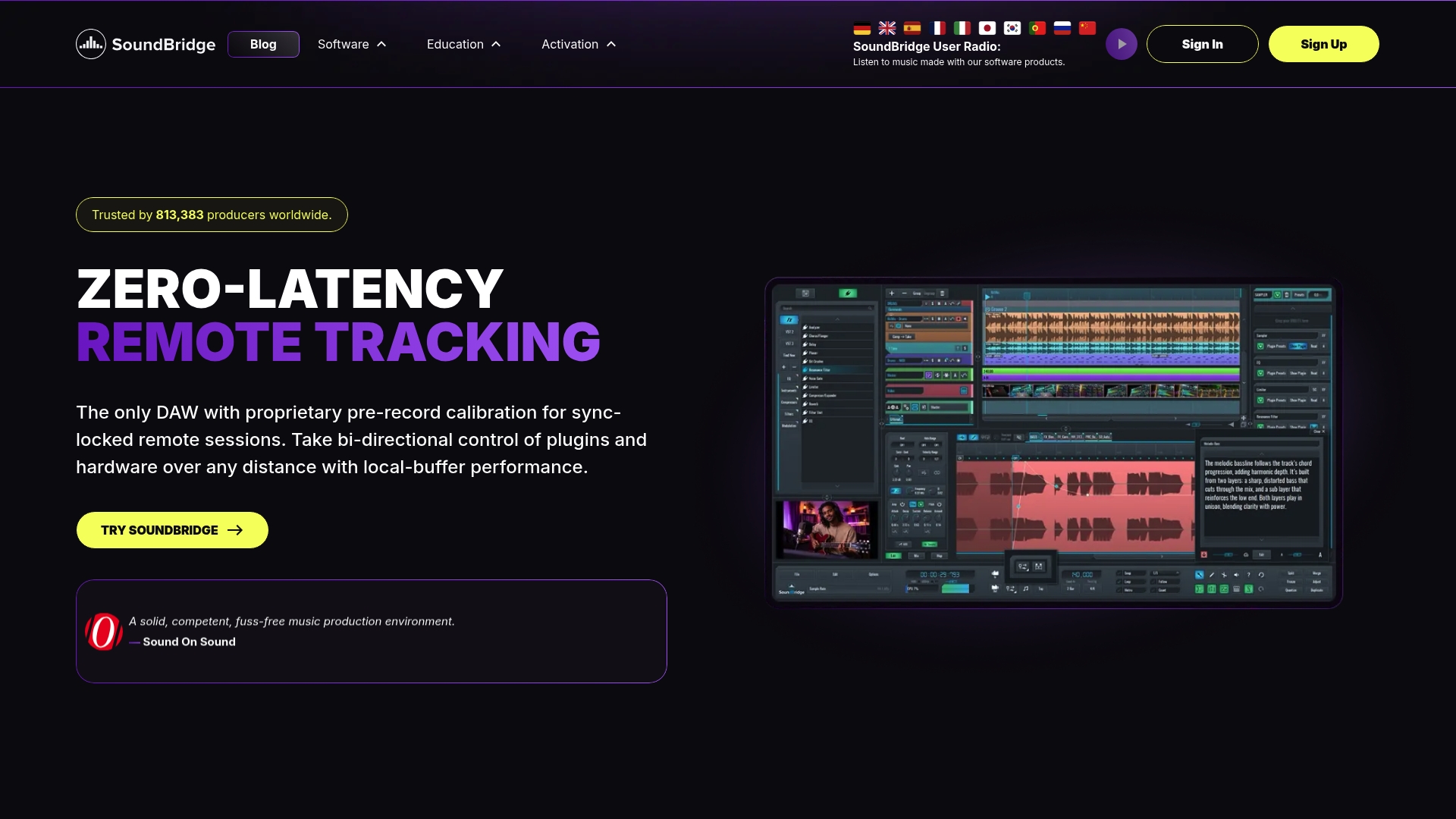
If you want a DAW built around the realities of remote production, Soundbridge is worth your time. It offers zero-latency remote recording with studio-accurate synchronization, integrated talkback and video, and support for 192kHz sample rates across Mac and Windows. You get the full DAW environment alongside the collaboration layer, so you are not stitching together separate tools to get a working remote workflow.
Soundbridge’s virtual collaboration workflow is designed for producers and engineers who need more than a simple jam session. If you are newer to the DAW side of things, the musician’s guide to DAWs is a solid starting point for understanding how the full production environment fits together with remote tracking. Both free and paid tiers are available, so you can test the platform before committing.
FAQ
What is the ideal latency for real-time music collaboration?
Sub-30ms round-trip latency is the accepted threshold for synchronous remote music performance. Below that level, most musicians cannot perceive the delay as a gap between playing and hearing.
How does band-app-v2 achieve low latency without streaming audio?
Band-app-v2 sends only control signals over the network and synthesizes audio locally on the host machine. This eliminates audio streaming delay entirely, with the host acting as the single timing authority using beat quantization.
Do I need a special audio interface for remote music sessions?
A dedicated audio interface with ASIO drivers on Windows or CoreAudio on Mac is strongly recommended. Generic USB audio introduces unpredictable driver latency that no collaboration software can fully compensate for.
What is the difference between Jamulus and OpenStudio?
Jamulus is a free, open-source desktop application that relies on community servers for low-latency jamming. OpenStudio is browser-based with an optional Rust native bridge for lower device latency, using Cloudflare Calls for edge audio routing.
Why does Wi-Fi hurt latency in music collaboration apps?
Wi-Fi introduces jitter, which is the inconsistent variation in packet arrival times. Even fast wireless connections can spike unpredictably, causing audio dropouts and timing drift that a wired ethernet connection avoids.
Recommended
MASTER MUSIC PRODUCTION
Expert-led courses designed to take you from fundamentals to finished tracks.
HOUSEFrom bouncy bass and solid kicks, this course teaches you the most modern House music production techniques needed to succeed and stand out.
TRAPQuit sounding like generic Trap and produce something World with hints of the Far East. Create ethnic soundscapes to put your Trap ahead of the curve.
AMBIENTProduce relaxing, sophisticated psy-influenced ambient. Psychedelic and relaxing to listen to, create meditative soundscapes to put your listeners in Zen.