

Mixing vs Mastering: A Producer's Clear Guide
Last Edited: Jun 18, 2026
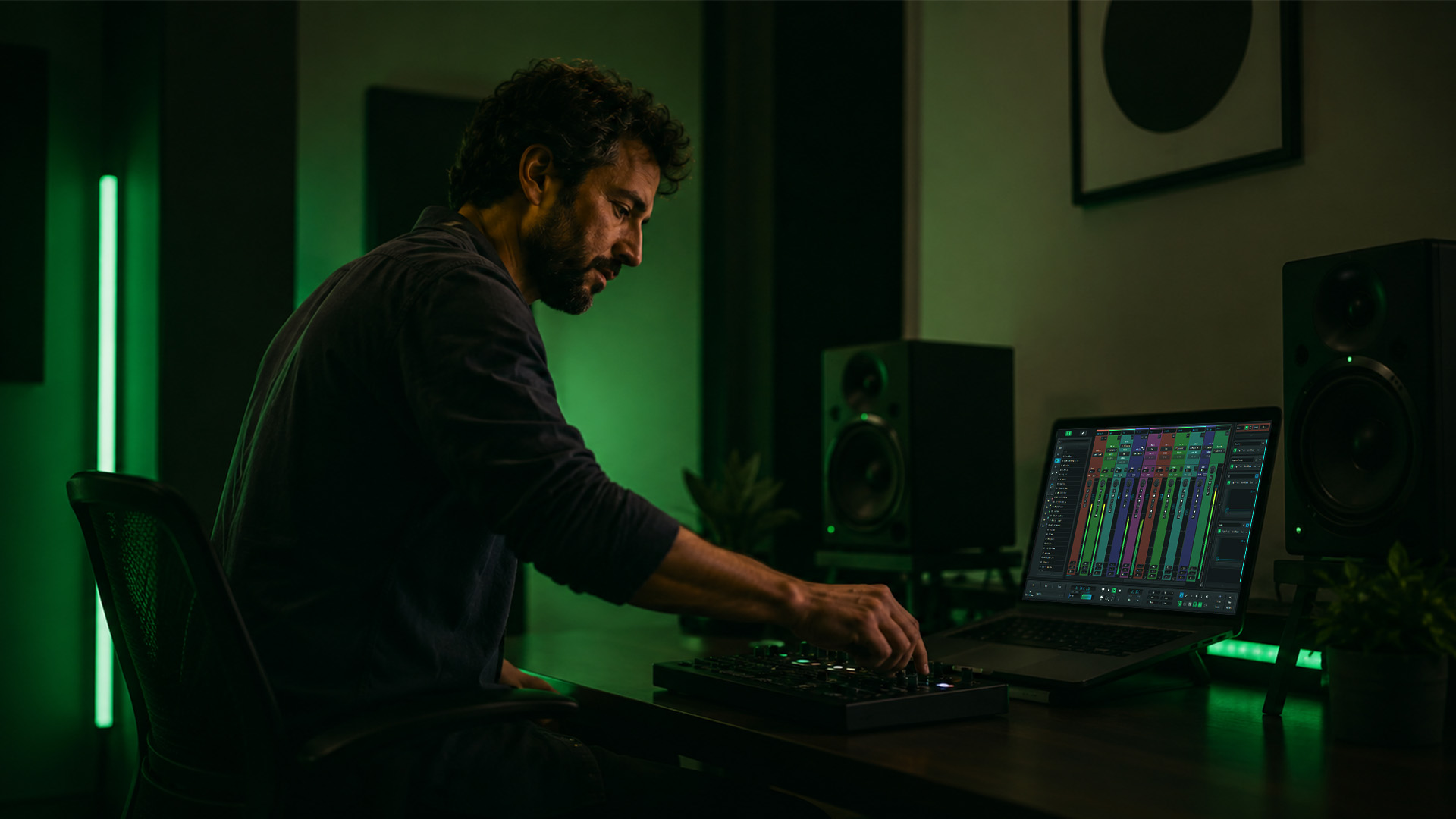
Mixing is the process of combining and balancing individual audio tracks into a single cohesive stereo file. At the same time, mastering is the final stage that polishes the stereo mix for distribution across all playback systems. Understanding the difference between mixing and mastering is the single most important workflow concept a producer can learn. Confusing the two leads to bad export decisions, wasted studio time, and mixes that fall apart on streaming platforms. Tools like iZotope Insight and standards like LUFS and true peak exist specifically to serve these two distinct stages, and knowing which belongs where changes everything about how you work.
What Does the Mixing Process Actually Involve?
Mixing combines and balances individual tracks into a cohesive stereo output. Every decision you make at this stage shapes the emotional and sonic identity of the song before a mastering engineer ever touches it.
The core work of mixing breaks down into these key activities:
- Level balancing and panning: Setting the volume and stereo position of every element, from the kick drum to the lead vocal, so nothing competes or gets buried.
- EQ and compression: Sculpting the frequency content of each track and controlling dynamics so the mix breathes naturally.
- Effects and automation: Adding reverb, delay, and modulation to create depth, then automating levels and effects to keep the listener engaged throughout the song.
- Reference track calibration: Using tools like iZotope Insight to compare your mix against professional references and catch frequency imbalances your ears miss after hours of work.
- Stem preparation: Organizing and exporting clean, well-labeled groups (drums, bass, vocals, synths) so the mastering stage has exactly what it needs.
Ear fatigue is the silent enemy of every mix session. After two or three hours, your brain starts compensating for problems it has heard repeatedly. This is why reference tracks are not optional. They reset your perception fast.
Pro Tip: Leave 3–6 dB of headroom on your master bus before export. A mix peaking at 0 dBFS leaves the mastering chain no room to add loudness cleanly, resulting in distortion or a flat, lifeless master.
Common mixing mistakes that hurt the final master include overcompressing the master bus, leaving tracks clipped, and applying heavy limiting before sending the file out. Each of these decisions removes options from the mastering engineer’s hands. The step-by-step mixing guide from SoundBridge walks through each stage in detail if you want a structured walkthrough.
What Happens During Mastering and Why Does It Matter?
Mastering works exclusively on the stereo mix file, not on individual tracks. That distinction is the entire point. The mastering engineer hears your song as a single entity and makes global decisions about tonal balance, loudness, and dynamic control.
Here is what the audio mastering process covers:
- Loudness normalization: Targeting integrated loudness levels measured in LUFS so your track plays back at the right volume on Spotify, Apple Music, and YouTube without the platform turning it down.
- True peak limiting: Spotify and Apple Music require a true-peak ceiling of -1 dBTP to prevent inter-sample clipping during encoding. This is different from standard sample-peak limiting and requires a true peak limiter.
- Tonal balance: Applying broad EQ moves to make the mix translate well on earbuds, studio monitors, car speakers, and phone speakers alike.
- Dynamic control: Using multiband compression or limiting to glue the mix together without squashing the life out of it.
- Format preparation: Exporting at the correct bit depth, sample rate, and file format for each delivery destination.
The EBU R128 loudness standard targets an integrated loudness of -23 LUFS and a maximum true peak of -1 dBTP for broadcast. Streaming platforms use similar targets, typically between -14 LUFS and -16 LUFS integrated. Knowing these numbers before you master means you are building toward a specific, measurable goal rather than guessing.
Pro Tip: Mastering cannot fix a poor mix. It polishes a good one. If your vocals are buried or your low end is muddy, those problems must be solved in the mix session, not at the mastering stage.
Stem mastering applies processing to grouped stereo stems (typically 4–8 groups) rather than a single stereo file. It gives the mastering engineer more control but adds cost and complexity. Full mix mastering remains the standard for most productions.

How Do Mixing and Mastering Differ and Complement Each Other?
The difference between mixing and mastering is not just technical. It is a difference in perspective, tools, and goals. Mixing is a detailed and creative work performed on dozens of individual tracks. Mastering is a holistic, precise process performed on a single stereo file.
Here is a direct comparison:
| Factor | Mixing | Mastering |
|---|---|---|
| What it works on | Individual tracks and stems | Final stereo mix file |
| Primary goal | Balance, clarity, and emotion | Translation, loudness, and format readiness |
| Key tools | EQ, compression, reverb, automation | Multiband compression, true peak limiter, LUFS meter |
| Skill focus | Creative detail and arrangement | Analytical listening and technical precision |
| Common mistake | Over-processing individual elements | Trying to fix the mix problems at this stage |
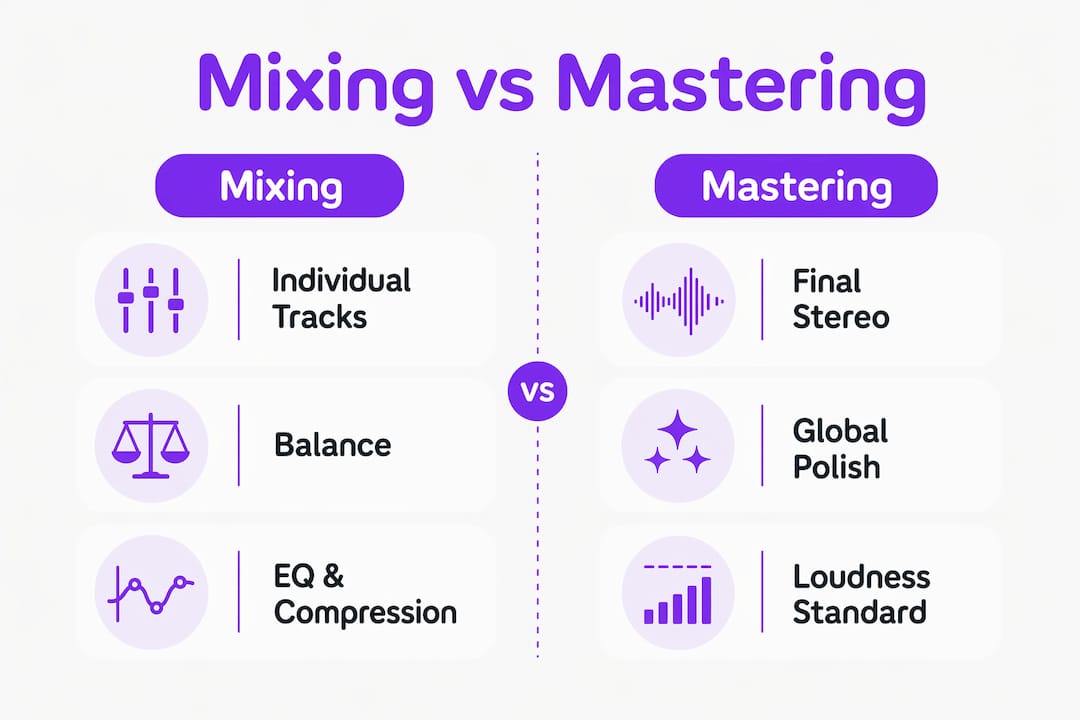
Mastering applies global polish, not isolated fixes. If the bass guitar is too loud relative to the kick, mastering cannot separate them. That relationship was locked in during mixing. This is the most common misconception producers carry into their first mastering session.
The workflow order is fixed: mixing always comes before mastering. The producer delivers stems to the mix engineer, who exports a stereo WAV, which the mastering engineer then processes. Skipping or reversing this order produces predictably bad results. Ear fatigue also demands that these stages happen at different times, ideally with a break of at least one day between finishing a mix and beginning to master it.
How to Prepare Your Mix for the Best Possible Master
Getting a great master starts with how you finish your mix. The decisions you make in the final hour of a mix session directly determine how much room your mastering engineer has to work.
Follow these steps before you export:
- Check your master bus peak level. Export mixes with 3–6 dB of headroom below 0 dBFS. This gives the mastering chain space to add loudness without distortion.
- Remove any master bus limiter. Print the mix without heavy limiting or clipping on the master bus. The mastering engineer applies their own limiting as part of the process.
- Finalize all automation. Lock in every volume ride, filter sweep, and effect send before you bounce. Changes after the fact mean starting the mastering process over.
- Check for clipping on individual tracks. Use a clip indicator on every channel. Even a single clipping track can introduce distortion that carries over into the final master.
- Reference your loudness. Use a LUFS meter to check your mix’s integrated loudness before export. Aim for around -18 LUFS to -20 LUFS on the mix so the mastering stage has dynamic range to work with.
- Decide between full mix and stem mastering. If specific elements need correction that full-mix mastering cannot address, stem mastering gives the engineer greater control over grouped buses. Keep in mind that the mix engineer’s bus decisions limit what the mastering engineer can change.
| Delivery Target | Recommended LUFS | True Peak Ceiling |
|---|---|---|
| Spotify / Apple Music | -14 LUFS integrated | -1 dBTP |
| YouTube | -14 LUFS integrated | -1 dBTP |
| Broadcast (EBU R128) | -23 LUFS integrated | -1 dBTP |
| CD / Download | -9 to -14 LUFS integrated | -0.3 dBTP |
Learning to make instruments punch through before you export also reduces the need for heavy mastering corrections later.
Common Myths About Mixing vs Mastering
A few persistent myths cause real problems for producers at every level. Here is what is actually true:
- “Mastering is easier than mixing.” Mastering requires a different skill set, not a simpler one. A mastering engineer needs a calibrated room, trained ears, and deep knowledge of loudness standards and codec behavior.
- “I should master first, then mix.” Mixing always comes before mastering. The mastering stage requires a finished, approved stereo mix as its starting point.
- “Mastering will fix my bad mix.” Mastering only applies global processing, not isolated fixes. A muddy low end or a buried vocal cannot be corrected at the mastering stage.
- “I can mix and master the same song in one session.” Fresh ears are a major reason to separate these stages. Mixing fatigue reduces objectivity. A mastering engineer hears the mix for the first time with a clean perspective, which is a genuine advantage.
- “Separate engineers are only for big budgets.” Even self-producing artists benefit from stepping away and returning to master with fresh ears, or from sending the mix to a dedicated mastering service.
Key Takeaways
Mixing and mastering are two separate stages that require different tools, skills, and perspectives, and the quality of your master depends entirely on the quality of your mix.
| Point | Details |
|---|---|
| Mixing works on individual tracks | Balance, EQ, compression, and effects shape each element before the stereo bounce. |
| Mastering works on the stereo file. | Global loudness, tonal balance, and true peak limiting prepare the mix for distribution. |
| Headroom is non-negotiable | Export mixes with 3–6 dB of headroom, so the mastering chain has room to work cleanly. |
| Mastering cannot fix mix problems. | Buried vocals and muddy bass must be corrected in the mix session, not at the mastering stage. |
| Fresh ears improve mastering results. | Separating mixing and mastering sessions by at least one day produces more objective decisions. |
Why I Think Most Producers Get This Backward
After years of working inside DAWs and studying how professional records are made, the pattern I see most often is producers spending 80% of their energy on mastering and 20% on mixing. That ratio should be flipped.
Mastering is a finishing process. It has real power, but that power is limited to what the mix gives it. When you hand a mastering engineer a mix with 6 dB of clean headroom, a balanced low end, and a vocal that sits right, they can make something genuinely great. When you hand them a clipped, over-compressed file, no amount of iZotope Ozone or analog hardware saves it.
The other thing I have learned is that ear fatigue is not a myth or an excuse. It is a real physiological phenomenon. After a long mix session, your brain literally stops hearing certain frequencies accurately. Walking away for a day and returning with fresh ears before you master is not a luxury. It is the difference between catching a problem and shipping it.
My honest advice: learn mixing deeply before you worry about mastering. Get your balances right, your low end clean, and your headroom consistent. The mastering stage will reward that discipline every time.
— Wake
Take Your Productions Further With SoundBridge
If you are ready to put these principles into practice, SoundBridge provides the tools to handle both stages effectively within a single platform. From high-fidelity audio processing at 192kHz to real-time remote collaboration with studio-accurate synchronization, SoundBridge is built for producers who take their workflow seriously.
Whether you are working through your first mix or preparing stems for a professional mastering session, the SoundBridge DAW guide covers everything you need to know about setting up your production environment. You can also explore the full audio mastering tutorial to get expert results in any DAW. SoundBridge is available on Mac and Windows with both free and paid tiers, so you can start building better mixes today.
FAQ
What is the core difference between mixing and mastering?
Mixing balances and processes individual tracks into a stereo file, while mastering applies global polish to that stereo file for distribution. The two stages use different tools and require different listening perspectives.
Can you master a song without mixing it first?
No. Mastering requires a finished stereo mix as its input. Attempting to master an unbalanced or unfinished mix yields poor results because mastering applies only global processing, not track-level corrections.
What loudness level should my mix hit before mastering?
Aim for an integrated loudness of around -18 LUFS to -20 LUFS on your mix export, with peaks no higher than -3 dBFS to -6 dBFS. This preserves dynamic range for the mastering chain to work with.
What is true peak limiting, and why does it matter?
True peak limiting controls inter-sample peaks that occur during codec encoding, not just the sample-level peaks visible in your DAW. Platforms like Spotify and Apple Music require a true-peak ceiling of -1 dBTP to prevent distortion during playback.
Should I hire separate engineers for mixing and mastering?
Separate engineers are the professional standard because fresh ears at the mastering stage catch problems that mix fatigue hides. Even if you self-produce, separating the sessions by at least a day delivers measurably better results.
Recommended
MASTER MUSIC PRODUCTION
Expert-led courses designed to take you from fundamentals to finished tracks.

HOUSEFrom bouncy bass and solid kicks, this course teaches you the most modern House music production techniques needed to succeed and stand out.

TRAPQuit sounding like generic Trap and produce something World with hints of the Far East. Create ethnic soundscapes to put your Trap ahead of the curve.

AMBIENTProduce relaxing, sophisticated psy-influenced ambient. Psychedelic and relaxing to listen to, create meditative soundscapes to put your listeners in Zen.