

When 40 Fixtures Must Sync: OSC vs MIDI for Lighting and Studio
Last Edited: Oct 13, 2026
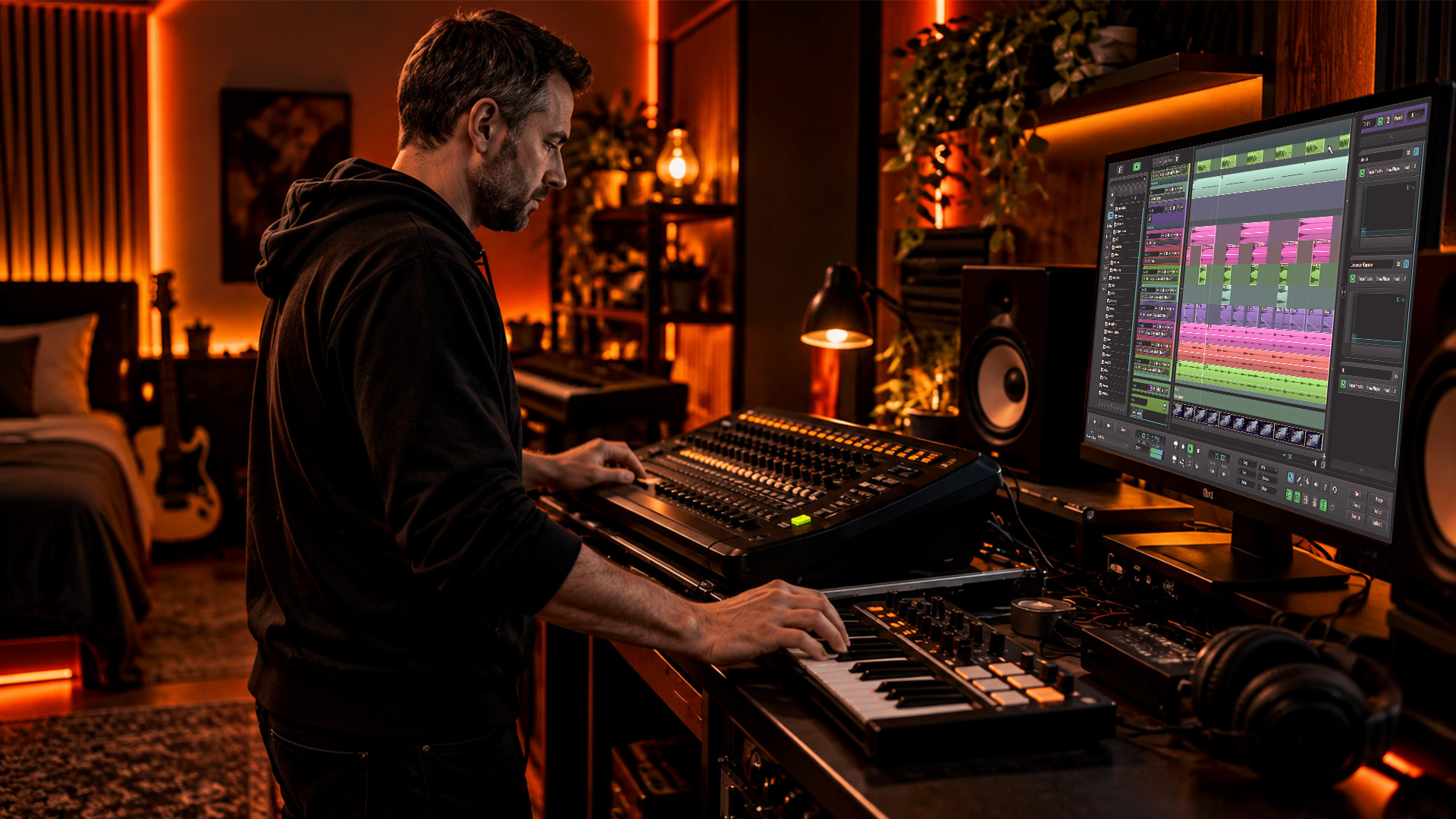
Choose OSC when you need networked, high-resolution control across lighting consoles, interactive installations, or distributed systems. Choose MIDI when you want plug-and-play instrument control that works with the massive ecosystem of DAWs and legacy hardware already built around it. MIDI 2.0 narrows the gap, but the core trade-off, network flexibility versus universal compatibility, still drives the decision.
TL;DR:
- OSC supports hierarchical addresses and high-resolution timetags, making it ideal for synchronized control of complex, networked lighting and interactive installations.
- MIDI remains the universal standard for instrument control and DAW integration, with lower setup overhead and broad hardware compatibility.
- MIDI 2.0 introduces higher resolution, device profiles, and bidirectional communication, narrowing the gap with OSC’s precision but still relying on its fixed message structure.
- Critical show-control OSC traffic should run over wired LAN with network isolation and backup measures like heartbeats to prevent timing issues during performances.
- Many productions use hybrid setups, bridging MIDI and OSC, and should prototype thoroughly while standardizing address spaces and profiles to avoid failures during live events.
OSC vs MIDI: A Side-By-Side Technical Breakdown
Before you commit to either protocol, look at how they actually move data. OSC rides on IP networks and speaks in flexible, named addresses. MIDI, even in its newest form, still carries the fingerprint of its hardware roots: tight, efficient, and built for instruments.
| Axis | OSC | MIDI |
|---|---|---|
| Transport | UDP/TCP over Ethernet or Wi-Fi | USB (MIDI 1.0), transport-agnostic via Universal MIDI Packet (MIDI 2.0) |
| Data resolution | floats, strings, structured types | 7-bit (MIDI 1.0) or higher-resolution via MIDI 2.0 |
| Timing | Bundles with high-resolution timetags | No native timetags in MIDI 1.0; MIDI 2.0 adds improved timing |
| Addressing | Hierarchical, URL-like, user-defined | Fixed channel and message model, extended by MIDI-CI Profiles |
| Best for | Networked show control, interactive art, multi-device rigs | Instrument control, DAW integration, legacy gear |
Those differences aren’t cosmetic. A lighting console that needs to fire a hundred parameters at once benefits from OSC’s structured addressing. A synth that needs note-on and note-off still runs beautifully on plain old MIDI.
How OSC Works: Addresses, Bundles, and Timetags
OSC organizes data the way a website organizes pages: through a hierarchical, URL-like address space. There’s no mandated global namespace, so you design your own, like /light/1/intensity or /synth/osc1/freqand that flexibility is both OSC’s biggest strength and its biggest risk.
Every OSC message carries a type tag describing its arguments. According to the OSC 1.0 specification, those tags cover integers, floats, strings, a dedicated MIDI blob type, and a high-resolution time tag. Messages can be grouped into bundles, allowing multiple parameters to update simultaneously under a single shared time tag, a feature documented in OSC’s own demo materials as a core advantage for synchronized show-control cues.
OSC typically travels over UDP for speed, though TCP is an option when you need guaranteed delivery. That choice matters: UDP drops the occasional packet but keeps latency low, while TCP guarantees arrival at the cost of added delay.

How MIDI Works: MIDI 1.0 Fundamentals and What MIDI 2.0 Adds
MIDI 1.0 sends a lean byte stream over a fixed-channel model, born from a 31.25 kbit/s serial connection that shaped decades of hardware design. It’s not glamorous, but it’s everywhere: synths, drum machines, controllers, and nearly every DAW speaks it fluently.
That universal adoption is MIDI’s real power. Plug in almost any controller, and it just works — no address mapping, no network configuration.
MIDI 2.0 builds on that foundation rather than replacing it. It introduces the Universal MIDI Packet, which makes MIDI transport-agnostic, along with MIDI-CI for device negotiation and Profiles that auto-configure compatible gear. Property Exchange lets devices share richer metadata than MIDI 1.0 ever allowed. The payoff: better resolution and bidirectional communication, while older MIDI 1.0 devices continue to work unchanged. For embedded and battery-powered gear, that lightweight heritage still means lower CPU and bandwidth demands than a full OSC implementation.
What These Differences Mean in Practice
Precision is where the split shows up fastest. OSC’s floating-point arguments give you finer control over parameters like intensity curves or spatial positioning, useful when a lighting designer needs a smooth fade rather than a steppy 128-value ramp. MIDI 1.0’s 7-bit resolution can feel coarse for that kind of expressive automation, though MIDI 2.0 closes much of that distance.
Setup overhead tells the opposite story. MIDI’s plug-and-play model means you connect a controller and start playing. OSC requires you to design and maintain a namespace, decide what /mixer/channel/3/gain means, and make sure every device on the network agrees. Skip that discipline, and you get silent failures or mismatched parameters across vendors.
Timing has real consequences on stage. OSC’s bundles and timetags let you schedule simultaneous events with precision, which matters when forty lighting fixtures need to change at the exact same instant. MIDI 1.0 lacks a native time-tagging mechanism, so tight synchronization across many devices relies more heavily on careful sequencing.
Resource usage favors MIDI on constrained hardware. OSC’s richer encoding and network stack carry more parsing overhead than MIDI’s compact byte-stream, a trade-off worth weighing on embedded controllers or older mobile devices.
Interoperability is OSC’s weak spot. Because there’s no mandated vocabulary, one vendor’s /fader1 is another’s /channel/1/level. MIDI’s fixed message types avoid that problem entirely, which is a major reason it has remained the default for cross-vendor instrument control for decades.

Choosing Between OSC and MIDI: A Practical Checklist
Run through these questions before you commit to a protocol for your next project:
- How many devices need to communicate, and are they on the same network or scattered across a venue?
- Do you need legacy hardware support, or is everything modern enough to handle networked control?
- How much parameter precision does the project actually require?
- How tolerant is the application of latency and the occasional dropped packet?
- Will multiple vendors’ gear need to interoperate without a shared namespace standard?
Many real-world rigs end up hybrid. You might bridge MIDI and OSC, embedding a MIDI blob inside an OSC message using the type tag the OSC 1.0 spec defines, or route MIDI 2.0 over a network transport entirely. Before locking anything in, prototype the setup, log the traffic, and standardize your namespace or MIDI-CI Profiles so nothing breaks on show night. When vetting a vendor or integrator, ask directly: does the device support timetags, which transports does it expose, and does it support MIDI-CI?
Avoiding Common OSC and MIDI Setup Mistakes
Run critical show-control OSC traffic over wired LAN whenever possible. Wi-Fi introduces jitter and packet loss that can throw off carefully timed cues. Isolate control traffic on its own VLAN and keep broadcast chatter away from your OSC stream.
If you’re using UDP for anything mission-critical, add heartbeats, sequence numbers, or application-level acknowledgments, since UDP itself offers no delivery guarantee. Publish your OSC address space as a shared dictionary so every device on the network agrees on what each address means, and verify your setup with a packet sniffer or logger before real performance testing.
For MIDI, pick hardware interfaces known for stable buffering, and use MIDI-CI Profiles, if your gear supports them, to reduce the need for manual channel mapping.
Pro Tip: Record and replay your OSC bundles and timetags during rehearsal. It’s the fastest way to catch timing drift before an audience does.
A practical take on picking your protocol
If you’re scoring a film or tracking a band, MIDI will carry you through almost every scenario; the ecosystem around it is too deep to ignore. If you’re building a networked lighting rig or an interactive installation with dozens of synchronized nodes, OSC’s addressing and timetags are worth the setup effort.
The mistake I see most often is treating this as an either-or decision when the strongest rigs quietly use both. Prototype early, standardize your namespace before you scale, and don’t reach for OSC’s flexibility just because it sounds more modern. Reach for it when your project’s architecture actually needs networked precision.
— Wake
Sources
For implementation details, start with the OSC 1.0 specification and MIDI.org’s MIDI 2.0 and MIDI-CI documentation. Both remain the authoritative word on message structure and device negotiation, and most lighting console vendors publish their own OSC notes worth cross-checking too.
If your next project involves tracking real instruments alongside any of this networked control work, a DAW built for high-fidelity routing helps. SoundBridge handles bidirectional control of plugins and hardware, along with zero-latency remote tracking, so musicians and producers working across MIDI gear and networked setups aren’t stuck stitching tools together. Its Free Version gets you started, and the Premium and Lifetime License tiers unlock the deeper routing and collaboration features once your rig grows. If you’re coordinating sessions remotely, SoundBridge’s virtual collaboration tools provide studio-accurate sync, with optional STUN/TURN access for $4.99 per month to ensure smoother remote connections. Explore the plans and see which fits your workflow.
FAQ
What does OSC stand for?
OSC stands for Open Sound Control, a network protocol developed at UC Berkeley’s CNMAT for sending structured, high-precision data between devices. It was built as a more flexible alternative to MIDI’s fixed message format.
What is OSC in networking?
In networking terms, OSC is a message protocol that typically travels over UDP or TCP on standard IP networks, according to its Wikipedia overview. It uses hierarchical, URL-like addresses rather than fixed channels, allowing devices to define their own custom parameter names.
What are OSC messages?
An OSC message pairs an address, like /mixer/gainwith a type tag describing its arguments, which can include integers, floats, strings, or even a MIDI blob, as defined in the OSC 1.0 specification. Messages can also be grouped into bundles with a shared timetag for synchronized delivery.
Who invented OSC?
OSC was developed in the late 1990s at UC Berkeley’s CNMAT, with contributors including Adrian Freed and Matt Wright named in the protocol’s origin history. It was designed to overcome MIDI’s resolution and addressing limits for networked control.
MASTER MUSIC PRODUCTION
Expert-led courses designed to take you from fundamentals to finished tracks.
HOUSEFrom bouncy bass and solid kicks, this course teaches you the most modern House music production techniques needed to succeed and stand out.
TRAPQuit sounding like generic Trap and produce something World with hints of the Far East. Create ethnic soundscapes to put your Trap ahead of the curve.

AMBIENTProduce relaxing, sophisticated psy-influenced ambient. Psychedelic and relaxing to listen to, create meditative soundscapes to put your listeners in Zen.