

Keep Clean at 4x: Component Aware Time Stretching Quality for Producers
Last Edited: Oct 13, 2026
Component aware processing, treating sines, transients, and noise as separate problems rather than one uniform signal, is what separates a clean time stretch from a smeared one. Transient handling matters most of all: it decides whether a stretched drum loop still sounds like a drum loop. Keep stretch ratios modest, reach for offline component aware tools on demanding material, and always audition attacks apart from tails before you commit.
TL;DR:
- Transient handling is crucial; over-stretching drums or plucked strings causes smearing and doubling artifacts that are easily audible.
- Off-the-shelf phase vocoders work well for tonal material but struggle with polyphony and noise, creating phasiness and metallic timbres at high stretch factors.
- Adaptive and neural-based methods improve quality by separating sines, transients, and noise, but they require more processing power and are best for offline use.
- Preprocessing steps like noise removal, level matching, and transient enhancement significantly improve final stretch quality and reduce artifacts.
- Short test loops at various settings are the fastest way to compare algorithms, with offline rendering preferred for final high-quality results.
1. What Makes Time Stretching Sound Clean: Sines, Transients, and Noise
Every audio signal you stretch is really three signals wearing a trench coat. Tonal or sinusoidal content is the steady, pitched part: a sustained string note, a vocal vowel, an organ pad. Transients are the sharp, broadband bursts that mark onsets: a snare crack, a plucked string, a consonant. Noise, or the residual, is the textured energy left over: breath, bow friction, cymbal wash, tape hiss. Good time stretching quality depends on treating these three differently, because stretching one badly ruins the perceptual illusion even when the other two survive intact.
Most stretching engines work in the frequency domain using a short-time Fourier transform, and that choice creates a built-in tension. A long analysis window gives you fine frequency resolution, which flatters tonal material and keeps pitch stable. A short window gives you fine time resolution, which protects transients. You cannot have both at once with a single fixed window, which is exactly why naive phase vocoder implementations struggle with mixed material like a full drum kit over a pad.
The failures show up in predictable places:
- A kick drum stretched with a long analysis window smears into a soft thud, losing its punch.
- A sustained pad stretched with a short window develops a grainy, unstable pitch because there is not enough spectral information per frame.
- Breathy vocal noise or cymbal wash, unless handled as its own component, can turn synthetic and metallic after stretching.
- Polyphonic material with both drums and tonal instruments in one file forces a compromise that flatters neither.
This is the core argument behind Aalto University’s objective evaluation research: perceptual quality is component-specific. Preserving pitch is not enough if the attack smears or the noise floor changes character. Any workflow aiming for high quality time stretch results has to account for all three components, not just the one that happens to be easiest to measure.
2. Recognizing Common Time Stretch Artifacts by Ear
Artifacts have distinct signatures, and learning to name them speeds up every fix that follows.
- Transient smearing softens attacks into a rounded swell, most obvious on drums and plucked strings.
- Phasiness adds a hollow, swirling quality to sustained tones, a side effect of phase relationships breaking down between frequency bins.
- Metallic timbre appears when noise components get resynthesized incorrectly, giving cymbals or breath a robotic edge.
- Transient doubling or skipping happens when the algorithm repeats or drops an attack while stitching frames together.
- Loss of presence shows up as a duller, more distant vocal or lead, even when pitch and rhythm are technically correct.
A fast listening checklist catches most of these before they reach a mix. Solo the attack of a hit or syllable and listen in isolation. Compare directly against the dry, unstretched reference at matched loudness. Listen in the full mix context, not just soloed, since some artifacts hide under other elements. Check both mono and stereo, since phasiness often worsens when summed to mono.
Instrument type changes what to listen for. Drums reveal transient smearing and doubling first. Vocals expose loss of presence and metallic sibilance. Sustained pads and strings are where phasiness lives, since long tonal content gives phase errors more time to accumulate.
Pro Tip: Bypass the stretch and A/B against the original at unity gain. Artifacts that vanish under scrutiny at low volume often reappear the moment you push a track to mix level.
3. Comparing Time Stretching Algorithms and When to Use Each
Choosing an algorithm is a job-to-be-done decision, not a search for one best time stretch algorithm to rule every session.
The classic phase vocoder handles tonal, harmonic content well at moderate stretch factors because it operates in the frequency domain where pitch information is easy to preserve. Its weakness is phasiness: as frames get stretched and overlapped, phase relationships between bins drift, producing that hollow, smeared character. Phase locking and magnitude correction techniques reduce this by keeping phase coherent across related bins, and they are why modern phase vocoder implementations sound noticeably better than early versions.
WSOLA and other time-domain, overlap-add methods take a different route: they find the best-matching waveform segments and splice them with cross-fades. This makes them robust and computationally cheap on percussive, transient-heavy material, since there is no frequency-domain phase to manage. The trade-off shows up on harmonic and polyphonic signals, where waveform matching struggles to find clean splice points and introduces its own warble or roughness.
Adaptive and multiresolution phase vocoder methods try to get the best of both worlds by varying window length based on signal content. SELEBI, a signal-adaptive approach using a nonstationary Gabor transform, assigns shorter windows to percussive regions and longer windows to tonal ones, which measurably reduces percussion smearing and sharpens attacks at large stretch factors compared with fixed-window approaches.
The newest tier separates sines, transients, and noise explicitly and resynthesizes each with dedicated methods, sometimes including neural models for the noise component. Research on extreme audio time stretching using neural synthesis found that this STN-plus-neural-resynthesis approach produced higher subjective listening scores than several baseline time-scale modification algorithms at extreme factors of 4x and beyond.
- Phase vocoder: solid tonal preservation at moderate ratios, prone to phasiness without phase locking.
- WSOLA and overlap-add: strong on percussive material, weaker on harmonic or polyphonic content.
- Adaptive and multiresolution PV including SELEBI: reduces percussion smearing through variable window length.
- STN with neural resynthesis: the best perceptual results at extreme factors, at the cost of offline compute and training data.
Real-time performance forces compromises that offline rendering does not. Live use cases need low latency, which usually means simpler, faster algorithms and smaller windows. When the final stem quality matters more than speed, offline rendering with adaptive or component-aware methods almost always wins, and extreme slowdowns are where neural approaches earn their computational cost.
4. Building a Practical Time Stretching Workflow
Quality starts before you touch the stretch control. Preprocessing decisions determine how much headroom the algorithm has to work with, and skipping them is the most common reason a stretch sounds worse than it needs to.
- Clean up noise, de-click, and remove any DC offset before stretching, since artifacts in the source get amplified by the process.
- Normalize levels so transient detection, which many algorithms rely on internally, has a consistent threshold to work against.
- Consider transient enhancement or de-emphasis beforehand if the material has weak or overly hot attacks that confuse onset detection.
- Choose window length by material: short windows protect transients, longer windows preserve tonal detail and pitch stability.
- Set overlap and hop size deliberately, since finer hop spacing improves smoothness at the cost of processing time.
- Match stretch ratio to material: speech tolerates roughly 0.9 to 1.1x safely, many musical passages hold up to around 2x with careful settings, and anything beyond about 4x calls for STN or neural approaches rather than a standard phase vocoder.
- Enable transient-preserve modes where available, or manually fix the analysis hop at known transient locations to stop the algorithm from smearing across a hit.
These ranges track with what independent tool documentation reports. AudioStretchy’s own documentation notes good speech results near 0.9 to 1.1x, while other tools document usable offline ranges extending toward 4x depending on algorithm and mode. The gap between those numbers is the gap between real-time and offline processing, and between speech-tuned and general-purpose algorithms.
Audition protocol matters as much as the settings themselves. Loop short excerpts rather than judging on a full pass, since ears fatigue and stop noticing artifacts after repeated listening. Render the same passage both offline and in real-time mode and compare directly, since many DAWs default to a faster real-time preview that understates final render quality. Document the settings you land on for each stem, since revisiting a session months later without notes means re-solving the same problem from scratch. Keep untouched originals archived separately, always, so a bad stretch never costs you the source material.
Pro Tip: Render a two-second test loop at three or four candidate settings before committing to a full stretch. The time spent comparing short clips is always cheaper than redoing a full render.
Preprocessing steps like de-noising and level matching overlap heavily with general audio editing fundamentals. Vocal stems in particular benefit from dynamic control before stretching to keep presence intact, a topic covered in more depth in guidance on serial compression for vocals.

5. How to Test and Measure Time Stretch Results
A short, repeatable listening test beats guesswork every time. Select a handful of excerpts that represent your problem cases: an attack-heavy drum hit, a sustained tone, and a noisy texture like a cymbal or breath sound. Normalize loudness across candidates using the ITU-R BS.1770 standard so volume differences do not bias your judgment, and check results on both headphones and monitors since artifacts can hide on one and appear on the other.
- Run blind A/B or MOS-style comparisons on each excerpt rather than judging algorithms by name or reputation.
- Score each clip on transient clarity, tonal stability, and noise texture separately instead of a single overall rating.
- Repeat the test after a break, since listening fatigue skews scores on longer sessions.
Objective diagnostics can support this process without replacing it. Tracking tonal, transient, and noise energy deviation curves against the original signal gives a quantitative view of where a stretch is failing. Aalto University’s evaluation research found that these energy-curve measures correlate with listener preference and work well as diagnostics, but the paper is explicit that they are not yet a substitute for subjective listening tests. Use them to locate a problem fast, then confirm the fix by ear.
6. Research Directions Worth Following in Time Stretching
Two research threads are pushing quality forward right now. STN decomposition combined with neural resynthesis handles the noise component separately, which the extreme time stretching research shows meaningfully improves results at severe stretch factors. Adaptive-window methods like SELEBI improve temporal localization around percussive hits, directly addressing smearing. Both approaches demand more compute and, for neural methods, training data, and both still rely on critical listening to confirm the gains hold up outside the lab.
7. An Engineer’s Checklist for Better Time Stretching
Audition attacks on their own before judging a full mix. Render final stems offline, never off a real-time preview. Write down your settings and archive the original file untouched. Stay conservative with extreme ratios, and lean on decomposition-based or neural methods only when a simple stretch genuinely cannot do the job.
— Wake
How SoundBridge Supports High-Quality Time Stretching
Getting component-aware results consistently means working in a DAW that treats high-fidelity processing as a baseline, not an upsell. SoundBridge processes audio up to 192kHz, giving stretching algorithms more spectral detail to work with before any artifact-prone compromise sets in.
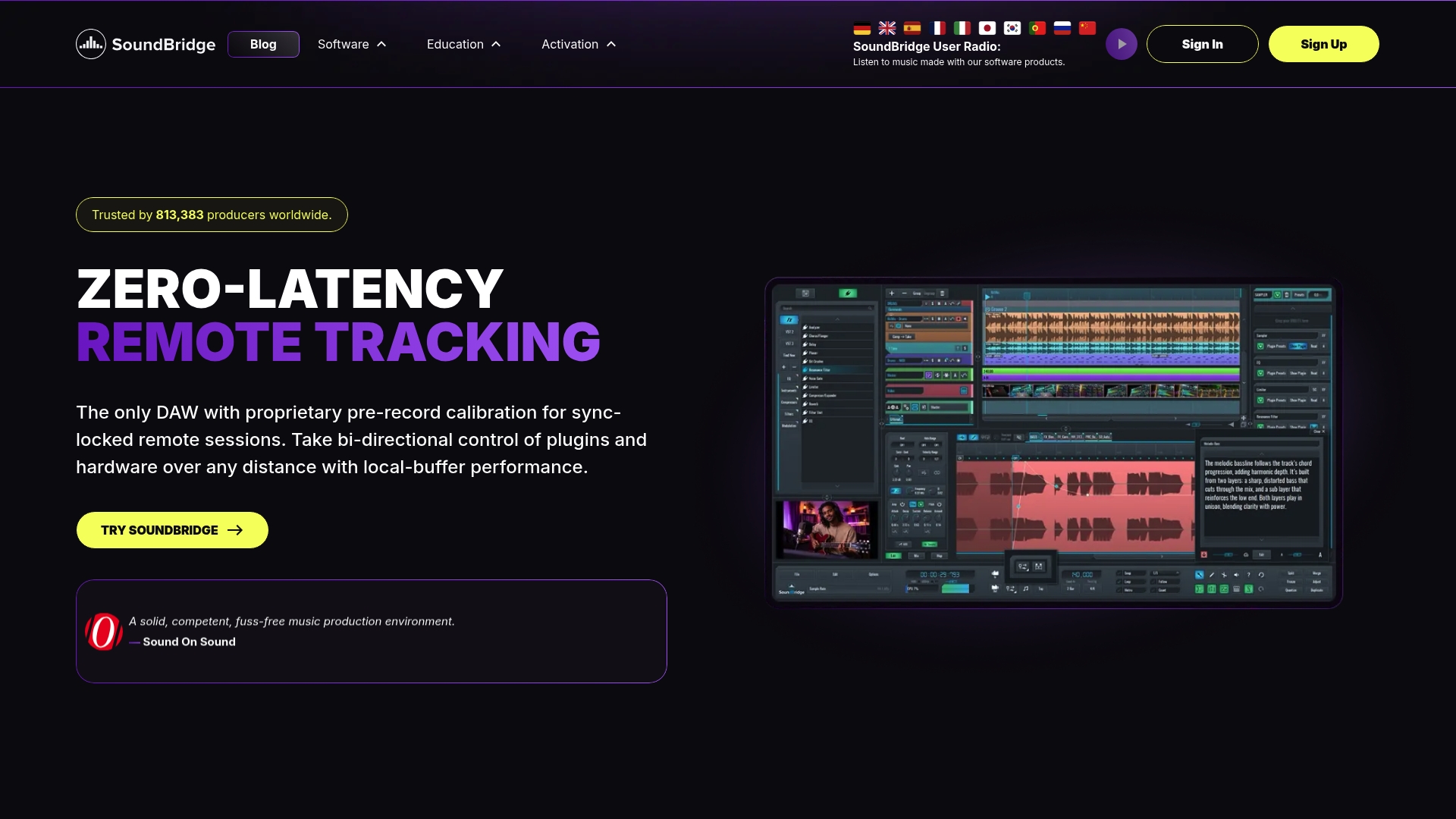
- Native time-stretching tools built into the workflow, so you are not bouncing stems out to a separate utility and losing time on round trips.
- Rendering options for processing that component-aware and adaptive methods require.
- Remote collaboration features allowing producers and mixing engineers to share and work on stretched stems together in real time.
- High-fidelity processing at up to 192kHz that gives transient detection and tonal resynthesis more accurate source material to work from.
If your next session involves a demanding stretch, whether it’s a half-time drum break or a vocal pulled to fit a new tempo, try SoundBridge and put these settings to work inside a single workflow built for the job.
Primary Sources and Further Reading
- Extreme audio time stretching using neural synthesis: STN decomposition with neural resynthesis for extreme stretch factors.
- SELEBI adaptive phase vocoder: signal-adaptive windowing that reduces percussion smearing.
- Aalto University objective evaluation research: component-specific diagnostics for time-scale modification.
- PyTorch Audio TimeStretch documentation: STFT-domain implementation details.
- Wolfram AudioTimeStretch documentation: general versus speech-specific stretching modes.
Read the listening-test sections of the cited papers directly for full methodology detail before applying their findings to your own sessions.
Sources
- Extreme audio time stretching using neural synthesis — arXiv
- Towards objective evaluation of audio time-scale modification methods — Aalto
- SELEBI: signal-adaptive phase vocoder approach — arXiv
- AudioTimeStretch — Wolfram Language Documentation
- torchaudio.transforms.TimeStretch — PyTorch Audio
FAQ
What is the best time stretch algorithm?
There is no single best option for every case: phase vocoder variants handle tonal material well, WSOLA suits percussive content, and STN-based neural resynthesis gives the strongest results at extreme factors according to recent research. The right choice depends on the material and whether you need real-time speed or offline quality.
Which DAW has the best time stretching?
Quality depends more on the underlying algorithm and your preprocessing than on any single DAW claiming superiority. SoundBridge includes native time-stretching tools alongside high-fidelity processing up to 192kHz and offline rendering, which supports the component-aware workflow described above.
What does time stretching mean?
Time stretching changes the duration or tempo of an audio signal while preserving its original pitch. It relies on algorithms, most commonly phase vocoder, WSOLA, or newer neural and decomposition-based methods, to separate timing from pitch information.
Is stretching for one hour good?
This question typically refers to fitness stretching routines rather than audio processing and falls outside what this article covers. For audio time stretching, safe ratios depend on material: tool documentation suggests roughly 0.9 to 1.1x for speech, with wider ranges usable for music when using offline, component-aware methods.
What causes phasiness in time-stretched audio?
Phasiness comes from phase relationships between frequency bins drifting apart as a phase vocoder stretches and overlaps frames, producing a hollow or swirling tone. Phase locking and magnitude correction techniques reduce this effect in modern implementations.
Recommended
MASTER MUSIC PRODUCTION
Expert-led courses designed to take you from fundamentals to finished tracks.

HOUSEFrom bouncy bass and solid kicks, this course teaches you the most modern House music production techniques needed to succeed and stand out.

TRAPQuit sounding like generic Trap and produce something World with hints of the Far East. Create ethnic soundscapes to put your Trap ahead of the curve.

AMBIENTProduce relaxing, sophisticated psy-influenced ambient. Psychedelic and relaxing to listen to, create meditative soundscapes to put your listeners in Zen.