


How to EQ Mono and Stereo Components Separately
Last Edited: Mar 6, 2026
In this article, we'll explore how to EQ mono and stereo components of a track separately to achieve cleaner low-end, more stable center imaging, and enhanced stereo depth. Rather than focusing on a specific plugin, the concepts discussed here apply broadly in any modern DAW that supports Mid/Side or dual-mono EQ workflows, making them relevant across a wide range of genres, mixing styles, and production environments.
In modern music production, equalization is rarely about simply boosting or cutting frequencies across an entire signal. As mixes become denser and stereo information becomes more complex, the traditional stereo EQ approach often lacks the precision needed to shape spatial balance and clarity properly.
A common limitation of standard equalizers is that they apply identical processing to both left and right channels, treating a stereo signal as a single, unified entity. While this is sufficient for basic tonal correction, it offers little control over how different elements occupy the center versus the sides of the stereo field.
For this reason, processing of mono and stereo components separately becomes essential. By addressing the mid (mono) and side (stereo) information independently, or by unlinking left and right channels entirely, engineers gain far greater control over focus, width, and translation across playback systems.
Establishing a Sonic Reference
Before introducing any processing, the first step is to listen to a short loop from the track without effects, allowing us to observe how the elements interact in their natural state.
This initial step reveals how stable the material feels, the stereo image, and whether certain elements already dominate the center or lean toward the sides. More importantly, it exposes where we actually need movement, depth, or correction.
Without this context, any form of processing becomes arbitrary. We cannot shape perception in isolation; it only gains meaning relative to the surrounding sounds. For that reason, the process begins by listening to the full mix before making any technical decisions.
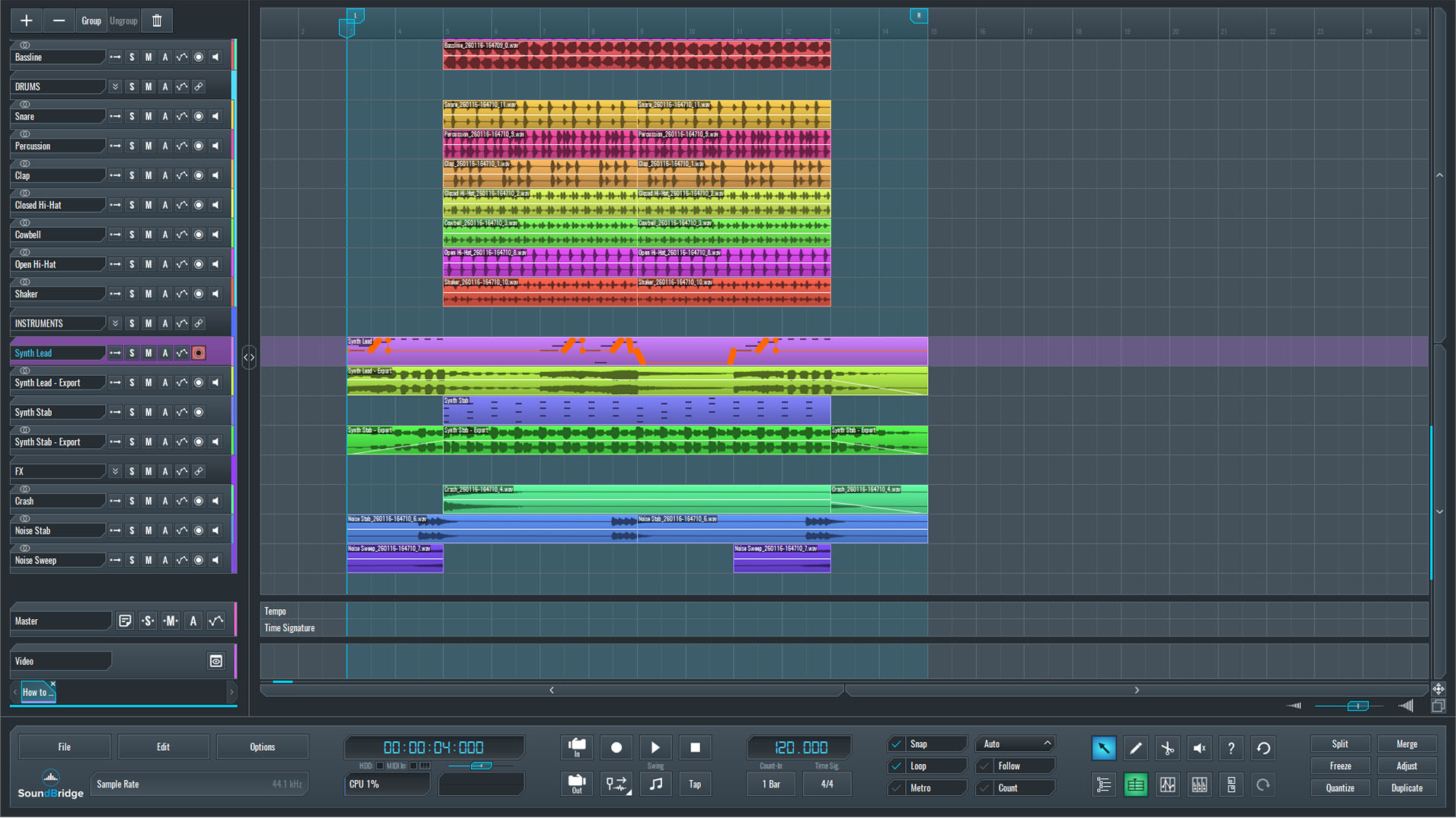
~Full Mix - Unprocessed.
Solo the Instrument Group to Prepare the Mono and Stereo Components for EQing
The effect of Mid/Side equalization is clearer when applied to a soloed instrument group, particularly one containing layered synth stabs and lead sounds. These elements typically occupy both the center and the sides of the stereo field, making them ideal for evaluating how mid- and side components interact.
When we isolate the instrument group, the changes introduced by the Mid/Side EQ become immediately audible. Adjustments to the mid channel affect focus and stability in the center, while side processing directly alters perceived width and spatial movement. With harmonically rich sources like synth stabs and leads, even subtle EQ differences between mid and side are easy to detect, allowing for precise control without relying on visual feedback.
Listening in isolation at this stage is not about final balance, but about clearly understanding how the Mid/Side EQ influences stereo distribution before we reintroduce the group into the full mix.

~Instruments Group - Solo (Unprocessed).
Setting up the EQ for EQing the Mono/Stereo Components
With the synth lead and stab channels routed into a single Instruments group, the next step is to define how the equalizer will interact with the stereo signal. We'll use Overtone GEQ, starting with its default configuration.
By default, Overtone GEQ operates in standard stereo mode, processing both left and right channels identically. In this state, any EQ adjustment affects the entire stereo signal, offering no distinction between centered and spatial content. While this is suitable for basic tonal shaping, it doesn't provide the level of control needed for targeted stereo manipulation.
To achieve the desired effect, switch the EQ to the Mid-Side Stereo mode available in the drop-down menu in the upper central area of the interface, just to the right of the Routing tab. The processor then separates the signal into mid (mono) and side (stereo) components, allowing independent shaping.
This mode is essential when working with layered synth leads and stabs, as it enables precise control over center focus and stereo width within the same group. From this point onward, every EQ decision directly influences how these elements interact spatially, rather than simply altering their overall tone.
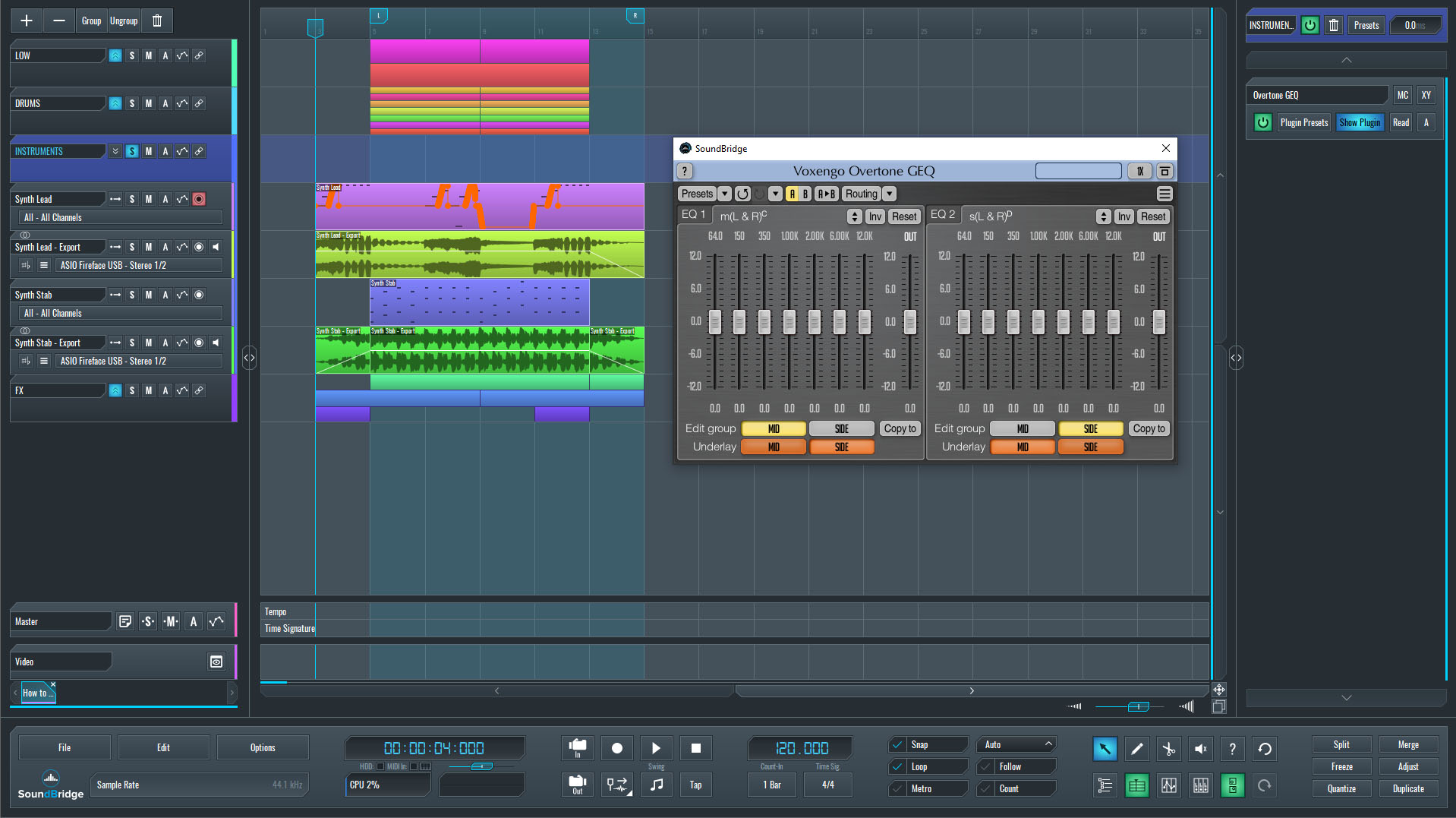
Focusing on the EQ 2 Section in Overtone GEQ
With Overtone GEQ now set to Mid-Side Stereo mode, the focus shifts to the EQ 2 section. We will use it to shape the synth lead and stab group more expressively. At this stage, the goal is not corrective EQ, but controlled enhancement in the mid- and high-frequency ranges. Most of the harmonic energy of these sounds resides in these frequencies.
As EQ adjustments are introduced in EQ 2, it's important to pay close attention to the interface itself. The faders on the left side remain at zero, indicating that we didn't boost the mid (mono) component. However, the frequency bands still show activity, indicating which ranges the processing affected. This visual feedback helps confirm that the EQ is active without altering the mono balance.
At the same time, the side section clearly reflects the applied boosts. The enhanced frequency bands are shown as alternating brown and white markers. These make it easy to identify which areas of the spectrum are being emphasized. The visual separation between mid and side allows for precise control. With this, we can add energy to the stereo content while keeping the center stable.
By concentrating boosts in the mid and high frequencies within the side signal, the synth leads and stabs gain presence and width without becoming unfocused or overpowering the mix. The interface itself becomes a guide, reinforcing how Mid/Side EQ decisions translate directly into spatial perception.
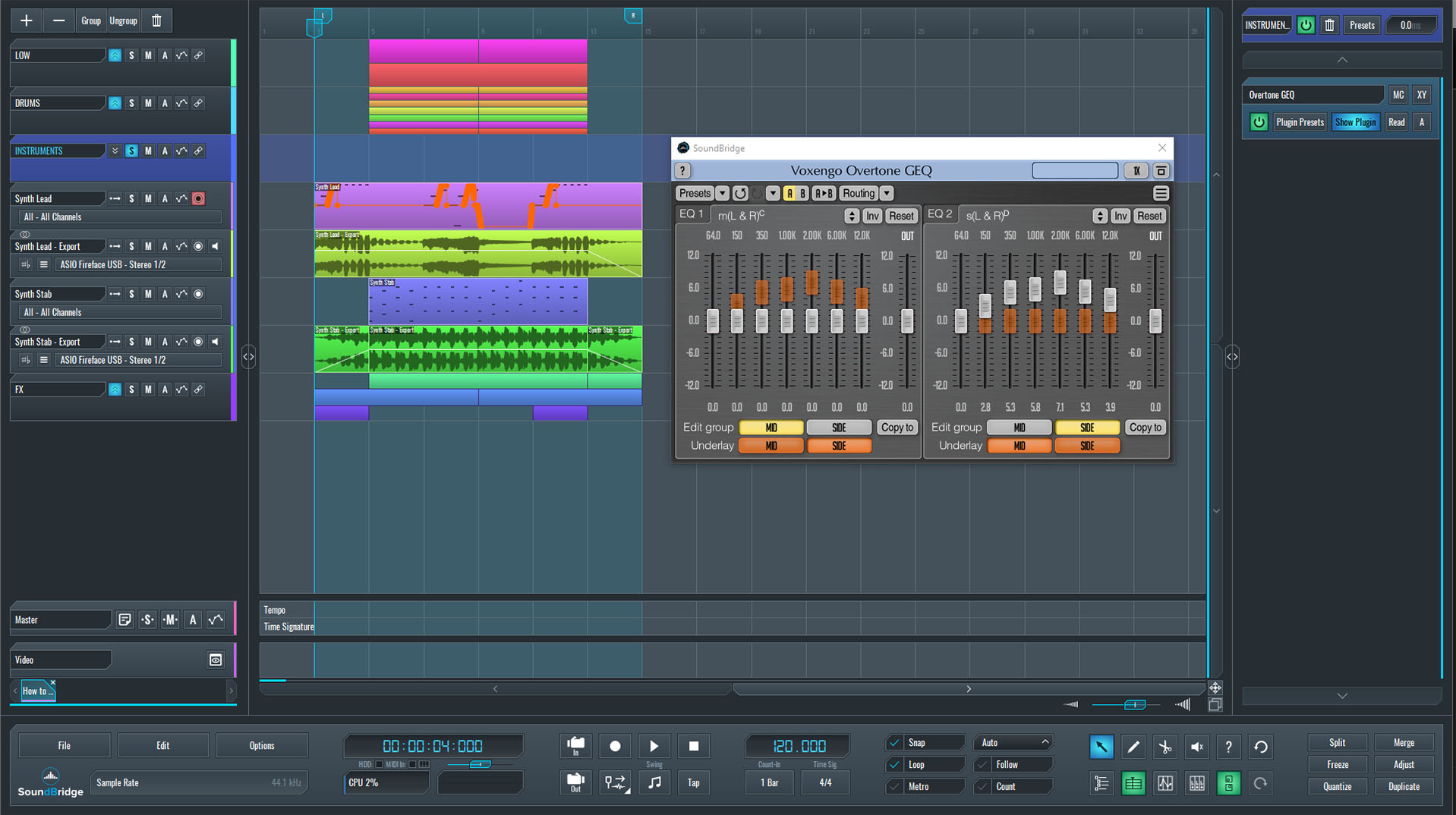
~Instruments Group - Solo (Processed With Overtone EQ).
From Isolation to Context: Hearing the EQ in the Full Mix
At this point, we should listen to the result within the context of the full mix. What sounded clear and expressive in isolation must now be evaluated against the surrounding elements. We do this to confirm that the processing enhances the overall balance rather than drawing unnecessary attention.
Reintroducing the instrument group into the mix reveals how the added side energy interacts with drums, vocals, and low-end elements. A stable mid channel ensures the center of the mix remains focused. On the other hand, side enhancements contribute to a wider, more open stereo image. At this stage, subtlety is key. All EQ moves should support the arrangement without shifting the listener's focus away from the core elements.
This approach is not limited to instrument groups. It can be applied to almost any type of audio components, including vocals, effects returns, and even full submixes. In particular, it becomes a powerful tool on the master channel, where gentle mid/side adjustments can refine stereo balance, improve clarity, and enhance perceived width without compromising mono compatibility.
With restraint, EQing mono and stereo components separately allows spatial refinement at multiple stages of a mix. It is a flexible and reliable technique well beyond the specific example demonstrated here.
~Full Mix - Instruments Group Processed With Mid-Side EQ.
Final Thoughts
Mid/Side equalization is a powerful technique, but its real value lies in subtlety rather than extremes. It allows precise control over focus, width, and spatial balance without disrupting the mix's natural cohesion. The goal is not to dramatically reshape the stereo image, but to gently guide the listener's perception.
This idea becomes especially important when applying the technique to the master channel. At that stage, even small adjustments can have a significant impact. Minor boosts or cuts in the side signal are often enough to enhance clarity and openness. Excessive processing can quickly compromise mono compatibility and overall stability.
Rather than exaggerated separation, the most effective results come from restrained moves that are felt more than they are heard. Developing the habit of level-matched A/B comparisons and frequent mono checks helps ensure that processing serves the music rather than the tool. Used this way, Mid/Side EQ becomes a method of refinement and balance, not a shortcut to artificial width.
If you liked this article on sound design, here are some more on the same subject:
DOMINA PRODUCCIÓN
Cursos con expertos para llevarte de fundamentos a tracks terminados.

HOUSECon bajos rebotones y kicks sólidos, este curso enseña técnicas modernas de producción House para destacar y triunfar.

TRAPDeja de sonar a Trap genérico y produce algo World con toques de Oriente. Crea paisajes étnicos para poner tu Trap por delante.

AMBIENTProduce ambient relajante y sofisticado con influencia psy. Psicodélico y relajante de escuchar; crea paisajes meditativos para llevar a tu público a Zen.